


Reviewed by [Registered Dietitian / Nutrition Credential]. This article is for educational purposes only and isn’t a substitute for personalized advice from a registered dietitian or physician.
Quick summary: A balanced diet for women means eating a mix of protein, whole grains, healthy fats, fruits, and vegetables while paying attention to nutrients women need in higher amounts — like iron, calcium, and folate. Conflicting advice online makes this harder than it should be. This guide breaks down what balance actually looks like, how needs shift across life stages, and how to build meals that fit into a real, busy week.
What Is a Balanced Diet for Women?
A balanced diet for women is an eating pattern that includes protein, whole grains, healthy fats, fruits, and vegetables in the right proportions, along with key nutrients like iron, calcium, folate, and vitamin D. It isn’t a strict rulebook you either pass or fail — it’s more like a general shape your meals tend to follow, most of the time, with the exact mix shifting a bit depending on your age, activity level, and life stage.
At its core, balance means getting enough of the nutrients your body actually uses — not just cutting things out. That distinction matters, because a lot of diet advice online focuses on restriction. This guide focuses on addition: what to build your plate around so your body has what it needs.
Quick Facts: Key Nutrients Women Need Daily
| Nutrient | Why It Matters | General Daily Guideline* |
| Protein | Muscle repair, satiety, hormone production | ~46 g (baseline for adult women) |
| Iron | Oxygen transport, energy, menstrual losses | 18 mg (premenopausal); 8 mg (postmenopausal) |
| Calcium | Bone strength, muscle and nerve function | 1,000 mg (ages 19–50); 1,200 mg (51+) |
| Folate | Cell growth, reproductive health | 400 mcg DFE |
| Vitamin D | Calcium absorption, bone and immune health | 600 IU (up to age 70); 800 IU (71+) |
| Vitamin B12 | Nerve function, red blood cell formation | 2.4 mcg |
| Fiber | Digestion, blood sugar balance, fullness | ~25 g |
*Figures reflect National Institutes of Health (NIH) dietary reference intakes for healthy adult women. Individual needs vary by age, pregnancy status, and health conditions — check with a healthcare provider for numbers specific to you. Bookmark this table as a quick balanced diet chart for women you can come back to.
Why Women’s Nutritional Needs Differ From Men’s
It’s not your imagination — women’s bodies genuinely need a different nutritional balance than men’s, and generic “eat healthy” advice often glosses right over this. In practice, this is really the story of daily nutrition needs for women shifting across life stages in ways that a one-size-fits-all plate rarely accounts for.
The biggest driver is the menstrual cycle. Regular blood loss during menstruation means premenopausal women need more than double the iron of men or postmenopausal women, simply to keep pace with what’s lost each month. That’s a big part of why fatigue and low iron are so common among women in their reproductive years.
Hormones add another layer. Estrogen and progesterone fluctuate throughout the month, and these shifts can influence appetite, cravings, mood, and even how the body handles carbohydrates. On top of that, reproductive health raises the importance of folate, which supports healthy cell division — something that matters whether or not pregnancy is currently on the radar.
Bone health rounds out the picture. Women are at higher risk for osteoporosis later in life. Part of this comes down to smaller bone frame size, and part comes down to the drop in estrogen around menopause, since estrogen helps protect bone density. That’s why calcium and vitamin D get so much attention in women’s nutrition specifically — the groundwork for strong bones later is largely laid decades earlier.
None of this means women need a completely separate diet from men. It means certain nutrients deserve a little extra attention on your plate.
Key Nutrients Women Need Daily
Which nutrients actually matter most here? A handful come up again and again in conversations about women’s health specifically — mostly because deficiencies in these areas are common, and the symptoms (fatigue, brittle nails, low mood) are easy to write off as “just being busy” rather than something worth a closer look at your plate. Think of this next section as a quick nutrition guide for women who want the highlights without a science lecture.
Iron and Anemia Prevention
If you’ve ever felt unexplainably drained despite sleeping enough, low iron might be part of the story. Iron helps red blood cells carry oxygen throughout the body, and because women lose iron through menstruation, the recommended intake for premenopausal women is more than twice that of men. When intake doesn’t keep up, it can lead to iron-deficiency anemia — one of the most common nutrient deficiencies among women, and one that’s easy to mistake for ordinary tiredness or stress.
Good sources include red meat, poultry, beans, lentils, and leafy greens like spinach. Pairing plant-based iron sources with a source of vitamin C (think beans with bell peppers, or spinach with citrus) helps your body absorb it more efficiently — our guide to [Internal Link Opportunity: iron-rich foods for women] goes deeper on specific meal ideas.
HealthWend Tip: Coffee and tea can reduce iron absorption if had right alongside an iron-rich meal. If you’re working on your iron intake, try leaving 30–60 minutes between your meal and your cup of coffee.
Calcium and Bone Health
Bone might feel like a distant concern in your 20s or 30s, but bone density peaks relatively early in life and gradually declines afterward — which is exactly why building strong reserves now pays off later, especially heading into menopause.
Calcium is the primary building block, but it doesn’t work alone — vitamin D is what allows your body to actually absorb it. Dairy products, fortified plant milks, canned salmon with bones, and leafy greens like kale are solid calcium sources, while sunlight exposure and fortified foods, along with foods like fatty fish, help cover vitamin D and, to a lesser extent, magnesium.
Folate and Reproductive Health
Folate supports the rapid cell division involved in reproduction, which is why it’s often mentioned in the context of pregnancy planning. It’s easy to forget about outside of that context, though — folate is also involved in red blood cell formation and general cellular health, which makes it relevant for women at every stage, not just when pregnancy is actively on the radar.
Leafy greens, beans, citrus fruits, and fortified grains are reliable sources. If pregnancy is a possibility for you, it’s worth having a conversation with your healthcare provider about folate specifically, since needs and recommendations can shift in that context.
Macronutrients: Protein, Carbs, and Fats
Diet culture has a habit of picking one macronutrient to blame each decade — carbs were the villain for a while, then fat took the blame, and now protein sometimes gets oddly over-hyped as the only thing that matters. In reality, all three play distinct, necessary roles, and a balanced diet makes room for each one.
Protein supports muscle repair, immune function, and hormone production, and it also helps you feel fuller for longer after a meal. Sources include lean meats, fish, eggs, dairy, tofu, beans, and lentils.
Carbs got a bad reputation somewhere along the way, but they’re actually your body’s preferred energy source — particularly for your brain and during physical activity. The type matters more than the total amount for most people: whole grains, fruits, vegetables, and legumes provide fiber and steadier energy, while heavily refined carbs tend to spike and then crash blood sugar.
Then there’s fat, which is essential for hormone production, vitamin absorption, and cell health — yes, including the fats involved in maintaining regular hormonal cycles, along with omega-3 fatty acids from sources like fatty fish, walnuts, and flaxseed. Unsaturated fats from olive oil, avocados, nuts, and fatty fish are generally the better everyday choice compared with heavily processed sources of saturated and trans fats.
There’s no single “correct” ratio that applies to every woman. What matters more is including all three groups regularly rather than eliminating one out of fear.
Building a Balanced Plate: A Practical Framework
Nutrition science is one thing; figuring out what to actually put on your plate tonight is another. A simple visual framework can bridge that gap without requiring you to track grams or calories.
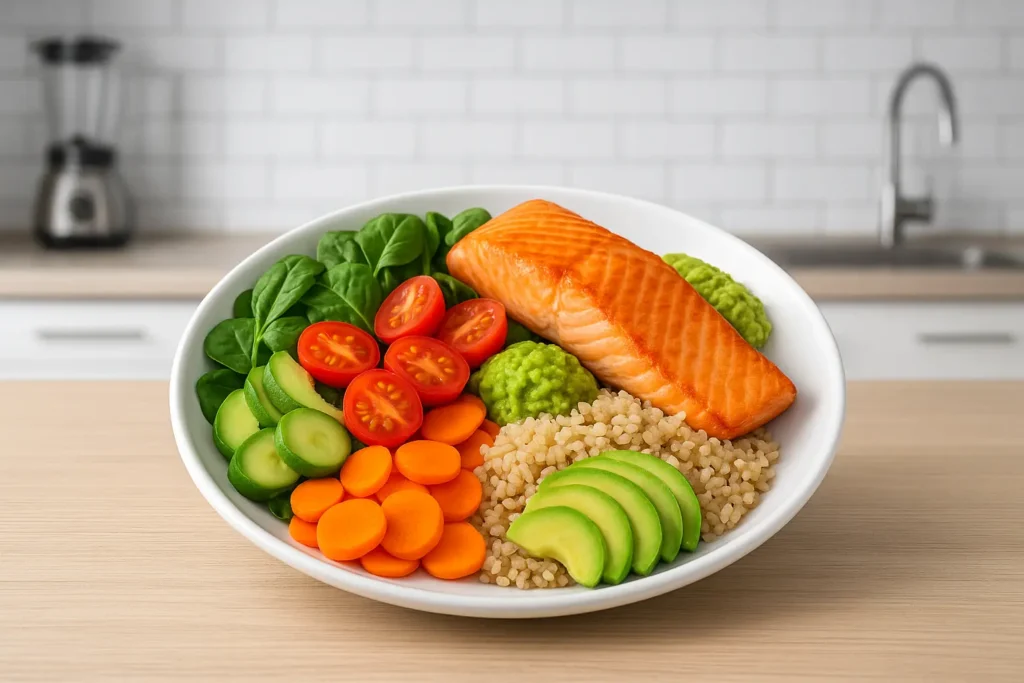
Picture your plate divided into rough sections: about half filled with vegetables and some fruit, a quarter with a protein source, and a quarter with a whole grain or starchy vegetable, with a small amount of healthy fat worked in (a drizzle of olive oil, a handful of nuts, some avocado). It’s less a rigid formula and more a mental shortcut — one that naturally builds in fiber, protein, and micronutrients without much extra thought.
Balanced Plate Checklist
| Plate Component | Example Foods | Approx. Portion |
| Vegetables & fruit | Leafy greens, broccoli, berries, citrus | About half the plate |
| Protein | Chicken, fish, eggs, tofu, lentils | About a quarter of the plate |
| Whole grains/starch | Brown rice, quinoa, sweet potato, oats | About a quarter of the plate |
| Healthy fats | Olive oil, avocado, nuts, seeds | Small amount, worked throughout |
This framework works whether you’re cooking at home, ordering takeout, or building a plate at a family gathering — you’re just looking for the general proportions, not perfection.
HealthWend Tip: At a restaurant, you can usually build this plate from a standard menu — a grilled protein, a side salad or vegetable, and a small starch swapped in for fries or extra bread does the job without needing anything special.
Balanced Diet Needs by Life Stage
Nutrition isn’t static — what your body needs at 22 isn’t quite the same as what it needs at 45 or 60. Hormonal shifts during pregnancy, perimenopause, and menopause change nutrient priorities in ways that generic diet advice often ignores entirely.
Life Stage Nutrient Comparison
| Life Stage | Key Nutrient Priorities | Notes |
| Teens/young adults | Iron, calcium, protein | Bone-building years; menstruation begins raising iron needs |
| 20s–30s | Iron, folate, protein | Reproductive years; folate relevant if pregnancy is a possibility |
| Pregnancy | Folate, iron, protein, calcium | Needs increase notably; requires individualized medical guidance |
| 40s–perimenopause | Calcium, vitamin D, protein | Bone density and metabolic shifts become more relevant |
| Menopause & beyond | Calcium, vitamin D, protein, fiber | Iron needs typically drop; bone and heart health take priority |
Balanced Diet During Pregnancy
Pregnancy increases the demand for several nutrients at once, particularly folate, iron, protein, and calcium, since your body is supporting rapid growth and development. This is one area where general guidance should give way to individualized care. Prenatal nutrient needs vary — by trimester, by health history, and by whether you’re carrying more than one baby — which is exactly why major health authorities recommend individualized prenatal nutrition guidance rather than a single standard target. If you’re pregnant or planning to be, it’s worth working directly with your OB-GYN or a registered dietitian to fine-tune your intake rather than relying on general averages — our [Internal Link Opportunity: nutrition during pregnancy] guide walks through what changes trimester by trimester.
HealthWend Tip: If you’re starting or adjusting a prenatal vitamin, run it by your provider first — some formulations and dosages are better suited to specific trimesters or health histories than others.
Also Read :Balanced Diet Benefits: Why It Matters for Your Health
Balanced Diet During Perimenopause and Menopause
As estrogen levels decline during perimenopause and menopause, bone density loss tends to accelerate, which is exactly why calcium and vitamin D become even more central during this stage. Protein needs also deserve attention, since maintaining muscle mass gets a bit harder with age. Some women notice shifts in weight distribution or appetite during this transition too — which is less about willpower and more about genuine hormonal change. For more on navigating this stage, see our [Internal Link Opportunity: menopause diet tips] guide.
Balanced Diet for Weight Management
If restrictive dieting has left you exhausted or distrustful of “weight loss advice” in general, you’re not alone — and the good news is that weight management doesn’t require a separate, more restrictive diet layered on top of everything else. The same balanced-plate framework — built around protein, fiber-rich carbs, vegetables, and healthy fats — tends to naturally support a sustainable calorie balance because it keeps you fuller for longer. Sustainable changes usually come from consistency over months, not from short bursts of restriction that are hard to maintain.
Sample Balanced Diet Plan for Women
Seeing a full day laid out can make the whole concept click faster than reading about macronutrients in the abstract. This is a flexible starting point, not a script — swap in what you actually enjoy and have access to.
Sample One-Day Meal Plan
| Meal | Example |
| Breakfast | Greek yogurt with berries, a drizzle of honey, and a sprinkle of walnuts |
| Mid-morning snack | An apple with a small handful of almonds |
| Lunch | Grilled chicken or chickpea salad with mixed greens, olive oil dressing, and whole-grain bread |
| Afternoon snack | Carrot sticks with hummus |
| Dinner | Baked salmon or lentils, roasted vegetables, and quinoa |
| Evening (optional) | A small square of dark chocolate or a piece of fruit |
Notice this isn’t about eating less — it’s about eating a wider variety across the day so different nutrient needs get covered naturally.
Ready to put this into practice? Download our free [Internal Link Opportunity: 7-Day Balanced Meal Starter — Lead Magnet] checklist to take the guesswork out of your first week.
Common Mistakes That Disrupt a Balanced Diet
Picture a rushed weekday morning: you’re out the door with just a coffee, skip breakfast entirely, and by 11 a.m. you’re foggy, irritable, and reaching for whatever’s closest. That energy crash isn’t a willpower problem — it’s usually just a missed meal catching up with you. Most nutrition missteps look like this: not dramatic, just small, repeated habits that quietly throw things off balance over time. A few of the most common ones worth watching for:
- Skipping meals to “save calories.” This often backfires by increasing hunger later and making it harder to hit protein and micronutrient targets across the day.
- Cutting out entire food groups. Eliminating carbs or fats entirely can lead to missing nutrients that are hard to get elsewhere, and it rarely leads to lasting results.
- Under-eating protein and iron-rich foods. This is especially common among women trying to eat “light,” and it’s a major contributor to fatigue.
- Relying on convenience foods without balance. A granola bar or coffee alone isn’t really a meal, even if it’s quick.
- Leaning on supplements to make up for an unbalanced diet. Supplements can fill genuine gaps, but they work best alongside a varied diet, not as a substitute for one.
- Copying a friend’s or influencer’s meal plan wholesale. What works for someone else’s age, activity level, or life stage may not match yours — the life-stage table above is a better starting point than a borrowed plan.
Recognize any of these? That’s not a failure — it’s useful information.
Myth vs. Fact
| Myth | Fact |
| Carbs make you gain weight | Excess calories from any source can contribute to weight gain — carbs themselves aren’t the enemy |
| Skipping breakfast helps you lose weight | It often leads to overeating later and disrupts steady energy throughout the day |
| You need a detox to “reset” your diet | The body already has functioning detox systems (liver, kidneys); consistent balanced eating supports them better than restrictive cleanses |
| Fat-free foods are automatically healthier | Fat-free products often replace fat with added sugar; healthy fats are a necessary part of a balanced diet |
None of this is about scoring yourself on a perfect day — it’s about spotting the patterns worth adjusting, one at a time.
Tips for Maintaining a Balanced Diet on a Busy Schedule
It’s one thing to know what a balanced plate looks like on paper. It’s another to build one on a Tuesday with back-to-back meetings, a school lunch to pack, and a commute squeezed in between. Many working women find that vending-machine snacks and a third cup of coffee become the default simply because nothing better is within reach. Plenty of parents notice they’re far more consistent about feeding their kids well than about feeding themselves — understandable, but worth gently correcting when possible. Sound familiar?
A few practical adjustments tend to help more than any complicated meal plan:
- Batch cook on a lower-stress day. Sunday meal-prepping — cooking a grain, a protein, and a few vegetables in bulk — means weekday meals become assembly, not cooking from scratch.
- Keep balanced snacks visible and accessible. If nuts, fruit, or yogurt are easy to grab, they’ll often win out over vending machine options simply through proximity.
- Build “good enough” meals for chaotic days. A rotisserie chicken, a bagged salad kit, and some fruit is a completely legitimate balanced meal — it doesn’t need to be elaborate.
- Set a recurring reminder to eat, not just to plan meals. Skipping meals during busy stretches is common, and a simple reminder can prevent the energy crash that follows.
HealthWend Tip: Keep a short “emergency meal” list on your fridge or in your phone notes — three or four go-to combinations you can throw together in under five minutes on the days when planning ahead just didn’t happen.
None of this requires becoming a different kind of person overnight. Small, repeatable systems tend to outperform ambitious plans that are hard to sustain.
Suggest Link : Healthy eating plans for women
Frequently Asked Questions
What is a balanced diet for women, and why is it important? A balanced diet for women includes a mix of protein, whole grains, fruits, vegetables, and healthy fats, along with adequate amounts of nutrients like iron, calcium, and folate. It matters because it supports steady energy, hormonal balance, and long-term protection against issues like anemia and bone density loss.
How many calories should the average woman consume per day? Calorie needs vary widely based on age, activity level, height, and goals, so there’s no single number that applies to everyone. A healthcare provider or registered dietitian can help calculate a range that’s appropriate for your specific situation.
What nutrients are women most commonly deficient in? Iron, calcium, vitamin D, and folate are among the nutrients women most commonly fall short on, often due to menstrual losses, limited sun exposure, or diets that don’t include enough variety.
How much protein should a woman eat for muscle and energy? The general baseline recommendation is around 46 grams per day for adult women, though active women or those focused on muscle maintenance often benefit from more. A dietitian can help tailor this to your activity level and goals.
What foods help balance female hormones naturally? No single food “balances hormones,” but a diet rich in fiber, healthy fats, and a variety of vegetables supports the body’s natural hormone regulation processes better than restrictive or highly processed eating patterns.
How does a balanced diet change during pregnancy? Pregnancy increases the need for folate, iron, protein, and calcium to support fetal development. Because needs vary by trimester and individual health factors, prenatal nutrition should be guided by an OB-GYN or registered dietitian rather than general guidelines alone.
What should women eat during menopause to manage symptoms? Calcium- and vitamin D-rich foods support bone health as estrogen declines, while adequate protein helps maintain muscle mass. Many women also find that consistent, balanced meals help smooth out energy and mood fluctuations during this transition.
Can a balanced diet help with PCOS symptoms? A balanced diet emphasizing fiber, protein, and steady blood sugar can be a supportive part of managing PCOS, but it isn’t a standalone treatment. PCOS management should be guided by a healthcare provider familiar with your specific symptoms and history.
What is the easiest way to plan balanced meals daily? Using the balanced-plate framework — roughly half vegetables/fruit, a quarter protein, a quarter whole grains, plus a source of healthy fat — takes the guesswork out of individual meals without needing to track exact numbers.
How can busy or working women maintain a balanced diet? Batch cooking on a lower-stress day, keeping balanced snacks within easy reach, and accepting “good enough” meals during chaotic weeks all help maintain consistency without requiring extra time most days.
Key Takeaways
- A balanced diet for women isn’t about restriction — it’s about consistently including protein, whole grains, healthy fats, fruits, and vegetables.
- Iron, calcium, folate, and vitamin D deserve extra attention due to menstruation, bone health, and reproductive considerations.
- Nutrient priorities shift across life stages — what your 20s-self needed isn’t identical to what you’ll need during pregnancy or menopause.
- The balanced-plate framework (half produce, a quarter protein, a quarter whole grains, plus healthy fat) simplifies daily meal planning without tracking numbers.
- Small, sustainable systems — like batch cooking and keeping snacks accessible — matter more for busy women than any complicated meal plan.
Conclusion
A balanced diet for women doesn’t have to mean rigid rules, calorie counting, or cutting out entire food groups. It’s really about consistently including the right mix of foods and nutrients — protein, whole grains, healthy fats, fruits and vegetables, along with attention to iron, calcium, folate, and vitamin D — while adjusting slightly as your life stage changes. Some days will look more “balanced” than others, and that’s completely fine. What matters most is the overall pattern over weeks and months, not any single meal. Start with one small shift — maybe that’s adding a vegetable to dinner, or batch-cooking on Sundays — and build from there.
Want more life-stage-specific guidance? Explore our full guides on [Internal Link Opportunity: Nutrition During Pregnancy] and [Internal Link Opportunity: Menopause Diet Tips] for deeper dives into these transitions.
Prefer nutrition tips delivered to your inbox? Join the HealthWend Women’s Nutrition newsletter for practical, evidence-based guidance every week.
This article is for educational purposes only and is not a substitute for professional medical or nutritional advice. Individual nutrient needs vary based on age, health conditions, and life stage — consult a registered dietitian or healthcare provider before making significant changes to your diet, especially during pregnancy or if you have an underlying health condition.