


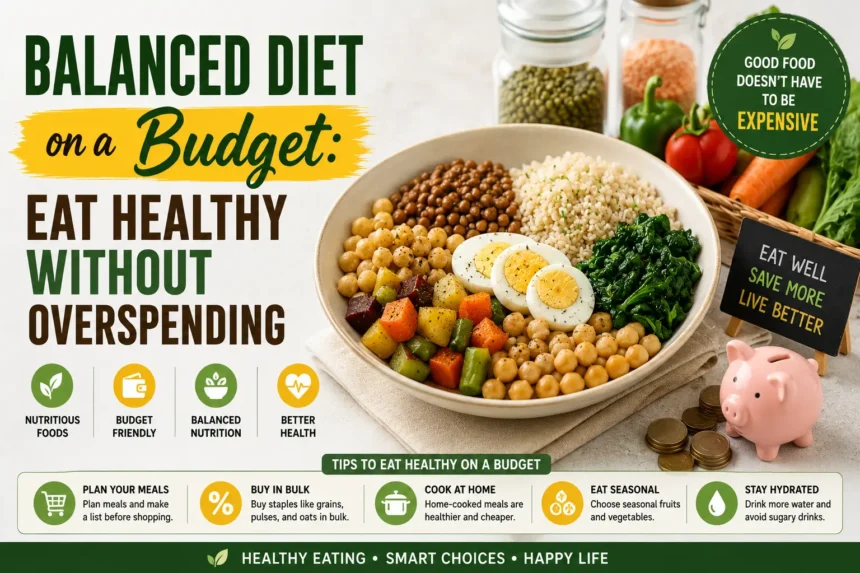
Reviewed for accuracy against USDA dietary and food-cost guidance by the HealthWend nutrition editorial team.
Short Summary: Eating well doesn’t have to drain your bank account. This guide breaks down how to build a balanced diet on a budget using affordable staples, a simple weekly planning system, and smart shopping habits — with a sample weekly budget grounded in official USDA figures, a pantry checklist, and practical tips you can start using this week.
Introduction
If you’ve ever stood in a grocery aisle doing mental math, wondering how you’re supposed to eat healthy and stay within budget, you’re not alone. It’s one of the most common tensions in modern eating — the idea that a balanced diet on a budget is basically a contradiction in terms. Fresh produce feels pricey, and “health food” marketing pushes expensive powders and specialty items. By the time you’ve paid rent and bills, the grocery budget is often what gets squeezed first.
Here’s the good news: it’s entirely possible to eat well without overspending, and you don’t need a nutrition degree or a big paycheck to do it. This guide walks through what a balanced diet actually looks like and why the “healthy is expensive” belief doesn’t hold up as well as you’d think. From there, we’ll build a realistic weekly plan around affordable, nutrient-dense foods, cover smart shopping strategies and batch cooking tips, and call out the mistakes that quietly drain grocery budgets without you noticing.
By the end, you’ll have a practical system you can actually use — not just another list of “eat more vegetables” advice.
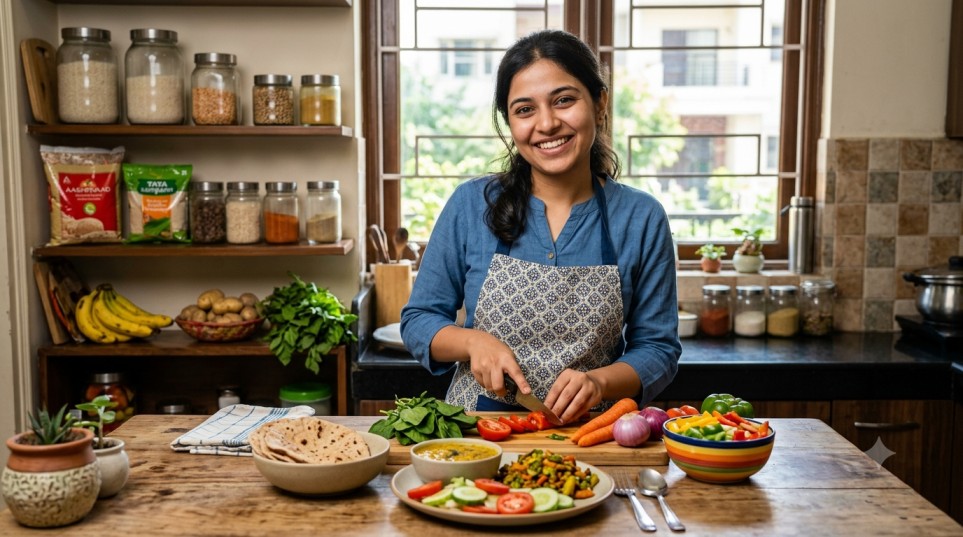
How Can I Eat a Balanced Diet on a Budget? (Quick Answer)
Featured Snippet Question: How can I eat a balanced diet on a budget?
Answer: Eating a balanced diet on a budget comes down to planning meals around affordable staples like beans, eggs, oats, frozen vegetables, and seasonal produce. Buying in bulk, cooking at home, batch-prepping meals, and reducing food waste all help stretch your grocery dollars while still covering your protein, fiber, and nutrient needs.
What Does a Balanced Diet Actually Mean?
Before we get into budgeting strategy, it helps to have a shared understanding of what “balanced” really means. A balanced diet isn’t about eating perfectly or cutting out entire food groups — it’s about getting a reasonable mix of macronutrients (protein, carbohydrates, and fats) along with the vitamins and minerals your body needs to function well.
In practical terms, that generally means including a source of protein, some whole grains or starchy vegetables, healthy fats, and a variety of fruits and vegetables across your meals. The USDA’s MyPlate framework is a useful, general reference point here — it emphasizes filling roughly half your plate with fruits and vegetables, with the rest split between protein and grains. The World Health Organization’s general healthy-diet guidance points in the same direction: a variety of foods across the major groups, limited added sugar and sodium, and meals built around whole rather than heavily processed ingredients.
None of this requires exotic ingredients. Some of the most nutrient-dense foods available — beans, eggs, oats, canned fish — also happen to be some of the least expensive items in the store. That’s the disconnect most people don’t realize until they actually start comparing.
HealthWend Tip: Next time you’re at the store, picture MyPlate as you fill your cart — roughly half produce, a quarter protein, a quarter grains. It’s a quick mental check that doesn’t require tracking a single number.
Why People Think Healthy Eating Is Expensive (Myth vs. Fact)
The belief that healthy eating is expensive usually comes from comparing the wrong things. Line up a bag of chips against a bag of quinoa, and sure, the “healthy” option looks pricier. But compare a home-cooked meal built around beans, rice, and vegetables to a fast-food meal or a box of processed convenience food, and the math often flips.
A lot of what actually drives up grocery bills isn’t the healthy stuff — it’s pre-packaged convenience, brand-name products, and impulse purchases. Whole, simple ingredients tend to be some of the cheapest items per serving in the entire store.
Here’s a quick reality check on some common assumptions:
| Myth | Fact |
|---|---|
| “Healthy food is always more expensive than junk food.” | Staples like beans, lentils, oats, and eggs are typically among the cheapest items per serving in any grocery store. |
| “You need organic or specialty products to eat healthy.” | A balanced diet can be built entirely from conventional, budget-friendly staples — organic isn’t required for good nutrition. |
| “Fresh produce is the only healthy option.” | Frozen and canned produce (without added sugar or heavy sodium) can be just as nutritious and often costs less. |
| “Eating healthy takes too much time, so takeout is more practical.” | Simple batch-cooked meals often take less active time per serving than repeated takeout runs, and cost significantly less. |
| “You need a lot of variety to eat a balanced diet.” | A small rotation of affordable, versatile staples can cover your nutritional bases without daily menu overhauls. |
Sound familiar? Most people have believed at least one of these at some point — the myths are common precisely because grocery marketing tends to reinforce them.
[Internal Link Opportunity: link to “What Is a Balanced Diet? A Complete Beginner’s Guide” using anchor text “understanding what a balanced diet means”]
Core Principles of Eating Well on a Budget
Once you let go of the idea that healthy eating requires expensive ingredients, the next step is building a system you can repeat week after week. Most successful budget eaters — whether they realize it or not — follow some version of the same four-step framework:
- Plan — Decide roughly what you’ll eat for the week before you shop, based on what’s on sale or in season.
- Shop — Buy with a list, focused on versatile staples rather than single-use specialty items.
- Prep — Cook in batches so healthy food is ready when you’re tired, busy, or short on time.
- Track — Keep a loose eye on what you’re spending so small leaks don’t add up.
The underlying idea here is nutrient density per dollar — choosing foods that give you the most protein, fiber, vitamins, and minerals for the lowest cost, rather than foods that are simply cheap in a calorie sense. A bag of white bread is inexpensive, but a bag of lentils often delivers far more nutritional value for a similar price.
This framework isn’t about rigid meal plans or restriction. It’s about giving yourself a repeatable structure so you’re not reinventing your grocery strategy every single week. With that framework in mind, the next question is the one most people actually start with: which foods should you build the plan around?
Cheapest Nutrient-Dense Foods to Stock Up On
Some foods consistently show up as smart choices for anyone trying to eat well without overspending — and they’re a direct application of the nutrient-density-per-dollar idea above. These aren’t trendy “superfoods.” They’re everyday staples that happen to punch well above their price point nutritionally.
Affordable Protein Sources
You’ll rarely find a cheaper source of protein than a bag of dried beans or lentils, and both come with the added bonus of fiber. Pairing legumes with a grain like rice or oats over the course of a day is a simple, well-established way to round out a fuller amino acid profile — a small pairing habit that costs nothing extra but adds nutritional value. Eggs are another reliable budget staple, delivering protein along with vitamin D and choline in a single, versatile ingredient. Canned fish, like tuna or sardines, and peanut butter round out a solid, affordable protein rotation.
[Internal Link Opportunity: link to “Cheap Sources of Protein for a Healthy Diet” using anchor text “affordable protein-rich foods”]
Affordable Whole Grains and Produce
Oats and brown rice are inexpensive, filling, and versatile — both work as a base for countless meals throughout the week. When it comes to produce, don’t overlook the frozen aisle: frozen vegetables are typically flash-frozen at peak ripeness, a process that locks in vitamins before they have a chance to degrade during shipping and storage, so they can rival fresh produce nutritionally while lasting far longer in your freezer. Buying fruits and vegetables in season is another simple way to keep produce costs down, since in-season produce is typically more abundant and less expensive to grow and transport.
Quick Facts: Cost-Effective Nutrient Sources
| Food | Typical Cost per Serving* | Key Nutrient(s) | Typical Serving |
|---|---|---|---|
| Lentils (dry) | Roughly $0.15–$0.25 | Protein, fiber, iron | ½ cup cooked |
| Eggs | Roughly $0.25–$0.45 | Protein, vitamin D, choline | 1–2 eggs |
| Oats | Roughly $0.10–$0.20 | Fiber, complex carbs | ½ cup dry |
| Frozen mixed vegetables | Roughly $0.40–$0.65 | Vitamins A & C, potassium | 1 cup |
| Canned tuna | Roughly $0.90–$1.50 | Protein, omega-3 fats | 1 can (approx. 3 oz drained) |
| Peanut butter | Roughly $0.15–$0.25 | Protein, healthy fats | 2 tbsp |
*These are general U.S. cost estimates based on typical grocery pricing and can vary by region, store type, and time of year. For exact figures, check current prices at your local grocer.
HealthWend Tip: When you’re comparing two similar products, check the unit price on the shelf tag (price per ounce or pound) rather than the total package price — it’s the fastest way to spot which option is actually cheaper per serving.
Expert Tip: Think in terms of cost per serving rather than cost per package. A larger bag of dried beans that yields a dozen servings is often cheaper per meal than a smaller processed product, even if the sticker price looks higher at checkout.
How to Build a Weekly Budget Meal Plan
With your staple foods identified, the next step is turning that list into an actual weekly plan. Start by picking 2–3 protein sources, 2–3 grains or starches, and a handful of vegetables to rotate through the week. From there, build 4–5 simple meal templates — grain bowls, soups, stir-fries, or egg-based dishes all work well — and vary them slightly day to day using what you have on hand. This kind of rotation also helps cut down on the decision fatigue that tends to creep in by Wednesday, when “what’s for dinner” starts to feel like its own chore.
A single person might build their whole week around one large pot of soup and a batch of grains, portioning it out as needed. A couple splitting grocery duties often does well by dividing planning and shopping tasks so no one person carries the full mental load. Retirees managing a fixed income tend to benefit from the same core approach, often shopping for staples every two weeks rather than weekly to reduce trips and take fuller advantage of sales. For a family of four, doubling recipes and leaning on freezer storage can stretch a single cooking session across several nights.
Sample Weekly Budget by Household Size
| Household Size | USDA Thrifty Food Plan Estimate (Weekly)* | Notes |
|---|---|---|
| Single adult | Roughly $55–$75 | Lower tier of the USDA’s four food-plan levels; assumes cooking at home and minimal waste |
| Two adults | Roughly $135–$150 | Includes the USDA’s standard household-size adjustment for two-person households |
| Family of four (2 adults, 2 children) | Roughly $225–$235 | USDA’s reference household; per-person cost is typically the lowest of any household size |
*Figures reflect the USDA’s Thrifty Food Plan — the most budget-conscious of the USDA’s four official food plan tiers (Thrifty, Low-Cost, Moderate, Liberal) and the same benchmark used to help set maximum SNAP allotments. The USDA updates these figures monthly for inflation, and actual costs vary by region, store type, and household composition, so treat this as a planning benchmark rather than a fixed target. For the most current figures, search “USDA Cost of Food at Home.”
Many parents notice that feeding picky eaters affordably comes down to keeping a few “safe” staples in regular rotation — eggs, pasta, or rice, for example — while gradually introducing new vegetables alongside familiar favorites.
[Internal Link Opportunity: link to “30 Budget-Friendly Healthy Recipes Under $2 Per Serving” using anchor text “budget-friendly recipe ideas”]
Smart Grocery Shopping Strategies
Having a plan is only half the battle — how and where you shop matters just as much. Shopping with a list, and ideally not on an empty stomach, helps avoid the impulse purchases that quietly inflate grocery bills. Where you shop also plays a real role: discount grocers and warehouse clubs often price staples like rice, oats, and canned goods noticeably lower than a standard supermarket, though warehouse clubs only pay off if you can actually use the larger quantities before they go bad.
HealthWend Tip: Many stores mark down perishable items — meat, dairy, bread, produce — later in the day or on set weekly schedules. Timing a shopping trip around those markdowns, or planning meals around whatever’s currently on sale, can meaningfully lower your weekly total without changing what you eat.
Store-Brand vs. Name-Brand Comparison
Store-brand and generic products are often nutritionally equivalent to name-brand versions — just packaged differently and priced lower. For staples like canned beans, frozen vegetables, and oats, the store brand is frequently the better value without any real trade-off in quality.
Pantry Staples Checklist
Keeping a well-stocked pantry means you’re rarely starting from zero when it’s time to cook. A solid budget-friendly pantry checklist looks something like:
- Dried or canned beans and lentils
- Eggs
- Oats and/or brown rice
- Canned tuna or sardines
- Peanut butter
- Frozen mixed vegetables
- Onions, garlic, and basic seasonings
- Canned tomatoes
- Whole wheat pasta
Grab a notepad and check off which of these you already have — the rest is your starting shopping list.
Pro Tip: Keep a small rotating list of “core” pantry items you never let run out. This alone eliminates a lot of last-minute takeout decisions born out of an empty fridge.
[Internal Link Opportunity: link to “Grocery Shopping Guide for Healthy Eating” using anchor text “smart grocery shopping tips”]
Also Read: Balanced Diet Meal Plan for Beginners
Batch Cooking and Meal Prep Tips
Cost isn’t the only barrier to eating well — time is a huge factor too. This is where batch cooking earns its keep. Setting aside an hour or two on a Sunday to cook a big pot of grains, a batch of beans, and a tray of roasted vegetables gives you the building blocks for several meals, ready to portion into containers as soon as everything cools.
For office workers, this kind of prep is often what makes the difference between packing an affordable lunch — say, a grain bowl with beans and roasted vegetables — and giving in to an expensive takeout order halfway through a busy week. Prepping even two or three lunches in advance can meaningfully cut down on both spending and decision fatigue.
Freezer-Friendly Meal Ideas
Not everything needs to be eaten within a few days. Soups, stews, cooked grains, and cooked beans generally freeze well and can be portioned out for later in the week — or later in the month. Cooking proteins like ground meat, shredded chicken, or lentil-based mixes in bulk and freezing them in meal-sized portions is a simple way to always have a base ready for a quick dinner.
[Internal Link Opportunity: link to “Batch Cooking and Freezer Meals for Busy Families” using anchor text “batch cooking and freezing tips”]
Reducing Food Waste to Save More
Even a well-planned grocery budget can leak money through food waste. Vegetables that wilt before you get to them, leftovers forgotten in the back of the fridge — it adds up more than most people realize.
A few small habits go a long way here. Storing produce properly — certain vegetables in the crisper drawer, others on the counter — extends freshness. Using leftovers creatively, like turning last night’s roasted vegetables into today’s grain bowl, helps nothing go to waste. If you live alone, freezing portions of anything you won’t finish within a few days is one of the simplest ways to stop wasted food from becoming wasted money.
HealthWend Tip: Practice “first in, first out” with your pantry and fridge — when you buy something new, move the older stock to the front so it actually gets used before it expires. It’s a small habit that catches a surprising amount of near-waste.
Read Also: Nutrition on a Budget
Common Mistakes to Avoid
It’s worth pausing here for a moment: a lot of the guilt people feel around grocery spending doesn’t come from doing anything wrong — it comes from a handful of quiet, easy-to-repeat patterns. A few of the most common ones:
- Buying specialty “diet” or “superfood” products instead of basic whole foods that offer similar or better nutritional value at a fraction of the cost.
- Skipping the planning step and grocery shopping without any real plan, which often leads to random purchases that don’t add up to complete meals.
- Shopping while hungry, which tends to result in impulse buys that blow past the intended budget.
- Letting fresh produce spoil before it gets used, often because too much was bought at once without a plan to use it.
- Overbuying perishable “bulk” items, like a large bag of spinach or a family pack of fresh chicken, that ends up spoiling before it’s all used — bulk buying only saves money if the food gets eaten.
- Treating every sale item as a good deal, even when it’s something you wouldn’t otherwise buy or use.
You may have experienced one or two of these yourself — most people have, and that’s not a sign you’re doing this wrong. It’s usually just a sign the system, not the effort, needs adjusting.
Frequently Asked Questions
What is considered a balanced diet? A balanced diet generally includes a mix of protein, whole grains or starchy vegetables, healthy fats, and a variety of fruits and vegetables. It’s less about perfection and more about consistently covering your nutritional bases across meals.
How much does it cost to eat healthy per week? According to the USDA’s Thrifty Food Plan — the most budget-conscious of its four official food plan tiers — a single adult can expect to spend roughly $55–$75 per week on groceries, two adults roughly $135–$150, and a family of four roughly $225–$235, though actual costs vary by region and store. Search “USDA Cost of Food at Home” for the latest published figures.
What are the cheapest sources of protein? Beans, lentils, eggs, canned fish, and peanut butter are among the most affordable protein sources, often costing significantly less per serving than meat.
Can I lose weight eating a budget-friendly diet? A budget-friendly, balanced diet can support general health goals, including weight management, when paired with appropriate portions and consistency. For individualized weight-loss guidance, it’s best to speak with a healthcare provider or registered dietitian.
How do I meal prep for a week on a budget? Start by choosing a few affordable staples, batch cook grains and proteins in advance, and portion meals into containers for the week. This reduces both cooking time and the temptation to buy convenience food.
What foods should I avoid to save money? Pre-packaged convenience meals, single-serve snack items, and specialty “diet” products tend to cost more per serving than whole, simple staples — cutting back on these is often where the biggest savings come from.
Are frozen vegetables as healthy as fresh ones? Yes, in most cases. Frozen vegetables are typically frozen shortly after harvest, which helps preserve their nutrient content, and they often cost less than fresh produce while lasting much longer.
How can I reduce food waste to save money? Store produce properly, use leftovers creatively, and freeze portions you won’t get to right away. Planning meals around what you already have on hand also helps minimize waste.
Is it possible to eat balanced meals with dietary restrictions on a budget? In many cases, yes — many affordable staples like beans, rice, and vegetables naturally fit a range of dietary needs. That said, individual restrictions can vary significantly, so it’s worth consulting a registered dietitian for personalized guidance if you have specific health or dietary requirements.
What’s a good starter grocery list for healthy eating? A solid starting list includes eggs, dried or canned beans, oats, brown rice, frozen mixed vegetables, canned fish, peanut butter, and a few basic seasonings. This covers protein, fiber, and a range of nutrients without requiring specialty items.
Key Takeaways
- A balanced diet doesn’t require expensive or specialty ingredients — staples like beans, eggs, oats, and frozen vegetables are both affordable and nutrient-dense.
- The plan-shop-prep-track framework gives you a repeatable system instead of starting from scratch every week.
- Store brands, bulk buying, and a well-stocked pantry can meaningfully lower your grocery costs without sacrificing nutrition.
- Batch cooking solves the time problem as much as the money problem — it’s often what keeps a budget-friendly plan sustainable.
- Reducing food waste is one of the simplest, most overlooked ways to save on groceries.
Conclusion
Eating a balanced diet on a budget isn’t about deprivation or complicated meal plans — it’s about building a simple, repeatable system around foods that are genuinely both affordable and nutritious. Once you shift the focus from “expensive health food” to nutrient-dense staples like beans, eggs, oats, and frozen vegetables, the math starts to work in your favor — the myths from earlier in this guide tend to fall apart pretty quickly once you’re actually comparing real prices side by side.
Start small if you need to. Pick a few staples, build a couple of meal templates, and give the plan-shop-prep-track approach a try for one week. You may find that eating well and staying on budget were never as incompatible as they seemed — you just needed the right system.
Calls to Action
Primary CTA: Download our free 7-Day Budget Balanced Diet Meal Plan to put this framework into action right away.
Secondary CTA: Curious what a balanced diet looks like in more detail? [Internal Link Opportunity: link to “What Is a Balanced Diet? A Complete Beginner’s Guide”]
Newsletter CTA: Want more budget-friendly nutrition tips delivered straight to your inbox? Sign up for the HealthWend newsletter.
Medical Disclaimer
This article is for educational purposes only and is not a substitute for professional medical or dietary advice. Cost figures are general estimates based on published USDA food plan data and may not reflect current prices in your area. If you have specific health conditions, dietary restrictions, or nutritional concerns, please consult a registered dietitian or healthcare provider for personalized guidance.