



Reviewed for accuracy by the HealthWend Editorial Team
Article Summary: Eating well as a man doesn’t have to mean tracking every gram or following a rigid plan. This guide breaks down what a balanced diet for men actually looks like — the nutrients that matter most, a simple method for building your plate, and real meal ideas you can use starting today, whether your goal is more energy, better long-term health, or just fewer confusing food rules.
You’ve probably noticed it happen without really deciding it would: takeout on Tuesday because work ran late, a protein bar standing in for lunch, coffee doing the job breakfast used to do. None of it feels like a crisis in the moment. But add it up over a few months, and it’s easy to end up wondering whether you’re actually eating well — or just eating.
That’s usually the point where “balanced diet for men” starts showing up in search bars. Not because anyone wants to become a nutrition expert, but because the advice out there is either too vague (“eat more vegetables”) or too complicated (macro spreadsheets, elimination phases, supplement stacks). What most guys actually want is simpler: a clear idea of what to eat, how much, and why it matters — without turning food into a second job.
This guide walks through the nutrients your body relies on most, a straightforward way to build a plate without counting anything, and real meal ideas for busy mornings, desk lunches, and everything in between. You’ll also find guidance for specific goals like building muscle, managing weight, or eating well past 40 — plus a few common detours (new parenthood, constant travel) that tend to throw even a solid routine off track.
This article is for general educational purposes and isn’t a substitute for personalized advice from a doctor or registered dietitian, especially if you have an existing health condition.
What Is a Balanced Diet for Men?
A balanced diet for men means eating a variety of foods in amounts that meet your body’s needs for energy, muscle repair, and overall function — not eliminating entire food groups or chasing a single “perfect” nutrient. In practice, that means combining lean proteins, whole grains, healthy fats, and a solid amount of fruits and vegetables at most meals, with portions sized to your activity level and goals.
It sounds simple because it is. Where people get tripped up is assuming “balanced” means bland, restrictive, or complicated to plan. It doesn’t. A balanced approach still includes the foods you actually enjoy — it just makes sure your plate consistently includes enough protein, fiber, and key vitamins and minerals alongside them.
Men’s nutritional needs also shift a bit based on age, activity level, and goals, which is why a 25-year-old lifting weights four times a week and a 55-year-old walking daily won’t eat identical plates — even though both can be following a genuinely balanced diet.
Quick Facts: Daily Nutrient Targets for Men
| Nutrient | General Daily Guidance | Why It Matters |
| Protein | Varies by body weight and activity level | Supports muscle repair, maintenance, and satiety |
| Fiber | Aim for a consistent daily intake from whole foods | Supports digestion, blood sugar balance, and fullness |
| Healthy Fats | Prioritize unsaturated sources; limit saturated fat | Supports heart and hormone health |
| Vitamin D | Often under-consumed, especially with limited sun exposure | Supports bone health and immune function |
| Zinc & Magnesium | Found in meats, nuts, seeds, and whole grains | Support immune function, muscle, and nerve health |
Note: Exact daily targets vary by age, weight, and activity level. For personalized numbers, refer to current guidelines from the USDA Dietary Guidelines for Americans, the NIH Office of Dietary Supplements, or a registered dietitian.
Why a Balanced Diet Matters for Men’s Health
It’s easy to treat nutrition as background noise until something forces you to pay attention — a rough physical, a friend’s health scare, or just noticing you’re gassed out by 3 p.m. every day. The case for eating well isn’t really about any single dramatic moment. It’s about what your diet is quietly doing in the background, day after day.
Consistent, balanced eating plays a role in maintaining steady energy, supporting muscle mass as you age, and contributing to long-term cardiovascular health. Men are statistically more likely to face certain health risks, including heart disease and type 2 diabetes, later in life. Diet isn’t the only factor at play, but the foods you eat regularly do influence things like cholesterol levels, blood sugar regulation, and metabolic health over time — a connection reflected in general guidance from organizations like the American Heart Association and the CDC.
There’s also a more immediate payoff. Men who eat balanced meals throughout the day often notice steadier energy, fewer mid-afternoon crashes, and better recovery from workouts or physically demanding days. You don’t need a lab report to feel that difference — most guys notice it within a couple of weeks of eating more consistently. If you’re curious exactly how many calories your day should include, [Internal Link Opportunity: How Many Calories Should a Man Eat Per Day] can help you work out a rough number based on your activity level.
None of this requires perfection. It’s more about the overall pattern across most days than any single meal.
Key Nutrients Men Need Daily
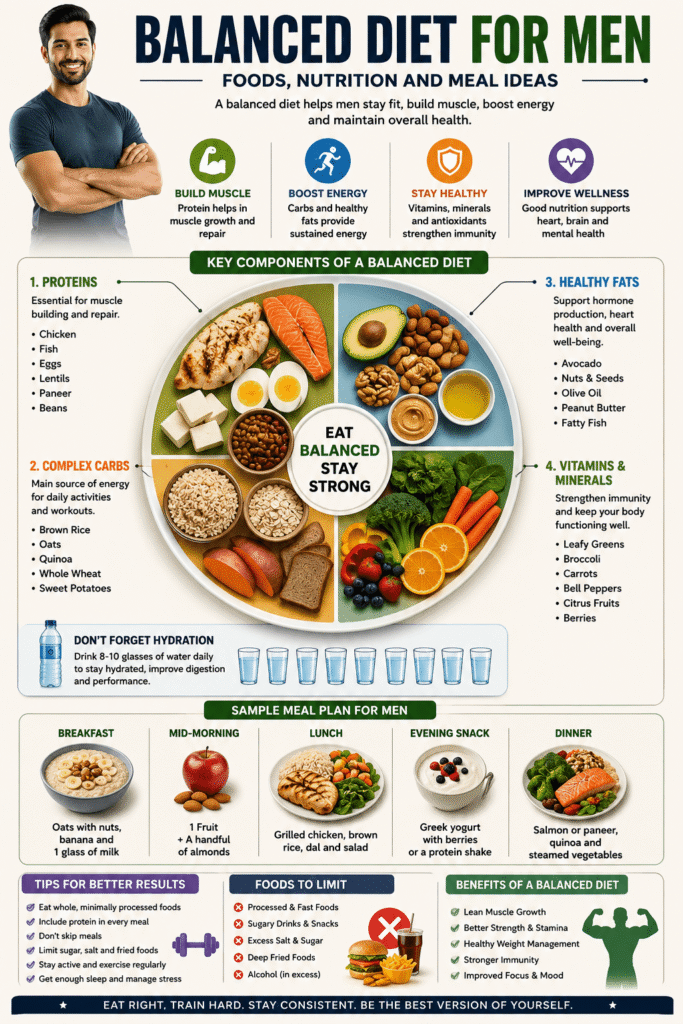
Before getting into meal ideas, it helps to understand what your plate should actually be built around. Four categories do most of the heavy lifting: protein, carbohydrates and fiber, healthy fats, and a handful of vitamins and minerals that tend to fly under the radar. Exact amounts vary from guy to guy — body size, activity level, and age all factor in — but the categories themselves stay consistent. Nutrition professionals commonly recommend building a meal around a protein source first, then filling in the rest of the plate around it, which is roughly the same logic behind the plate method later in this guide.
Protein Needs for Men
How much protein do you actually need? It depends on your body weight, activity level, and goals — but most adult men benefit from including a source of protein at every meal rather than loading it all into one sitting.
Protein plays a central role in repairing and maintaining muscle, which matters whether you’re actively working out or simply going about a physically demanding day. It also helps with satiety — meals with adequate protein tend to keep you full longer than carb-heavy meals alone.
Good sources include lean meats, poultry, fish, eggs, Greek yogurt, and plant-based options like lentils and beans. You don’t need to rely on protein powder to hit your targets; whole-food sources generally come with the added benefit of other nutrients your body needs too. If you eat on the road often — hotel breakfasts, airport terminals, whatever’s open near the office at 7 a.m. — eggs, Greek yogurt, and pre-packaged nuts travel a lot better than they get credit for. [Internal Link Opportunity: High-Protein Foods for Men]
HealthWend Tip: Pair a protein source with some fiber at each meal — think eggs and whole-grain toast rather than eggs alone. The combination tends to keep you full longer than either one on its own.
Carbohydrates and Fiber
Carbs get an unfair reputation. Somewhere along the way, “healthy eating” started being equated with “cutting carbs,” but for most men, whole-grain carbohydrates are actually one of the most useful tools for staying full and energized throughout the day.
The distinction that matters is quality. Whole grains, oats, brown rice, and legumes provide fiber alongside their carbohydrate content, which slows digestion, supports blood sugar stability, and helps you feel satisfied after eating. Refined carbs — white bread, sugary cereals, pastries — don’t offer the same benefit, even though they contain similar amounts of energy.
Fiber deserves its own mention here, since it’s one of the most commonly under-consumed nutrients among men. Beyond digestion, adequate fiber intake is linked to better cholesterol levels and more stable energy between meals.
Healthy Fats
Fat isn’t the enemy it was once made out to be — it’s a matter of type. Unsaturated fats, found in foods like olive oil, avocados, nuts, and fatty fish, support cardiovascular health and play a role in hormone production. Omega-3 fatty acids in particular, found in salmon, sardines, and walnuts, are worth prioritizing — heart-healthy eating guidance from organizations like the American Heart Association generally points in this same direction, favoring unsaturated sources over saturated ones.
Saturated fat, more common in processed meats, fried foods, and certain dairy products, is worth keeping in moderation rather than cutting entirely. The goal isn’t a fat-free plate — it’s shifting the balance toward the unsaturated sources more often than not. [Internal Link Opportunity: Best Foods for Men’s Heart Health]
Key Vitamins and Minerals (Zinc, Magnesium, Vitamin D, B12)
This is the category most generic diet advice skips entirely, which is a shame, because a handful of micronutrients do a lot of quiet work for men specifically.
- Zinc supports immune function and is found in meat, shellfish, seeds, and legumes.
- Magnesium plays a role in muscle and nerve function and shows up in nuts, seeds, leafy greens, and whole grains.
- Vitamin D supports bone health and immune function, and many men fall short, especially with limited sun exposure — fatty fish, fortified foods, and eggs are useful dietary sources.
- Vitamin B12 supports energy metabolism and is found primarily in animal products, which is worth noting if you eat a largely plant-based diet.
This is general educational information, not a diagnosis. If you suspect a deficiency in any of these, resist the urge to self-treat with heavy supplementation — bloodwork through a doctor is the most reliable way to know for sure, and it’s a far more direct route than guessing based on symptoms alone. [Internal Link Opportunity: Vitamins and Minerals Men Need at Every Age]
Nutrient Overview Table
| Nutrient | Role in the Body | Good Food Sources | General Daily Focus |
| Protein | Muscle repair, satiety | Lean meats, eggs, fish, legumes | Include at every meal |
| Fiber | Digestion, blood sugar balance | Whole grains, vegetables, legumes | Prioritize whole-food carbs |
| Healthy Fats | Heart and hormone health | Olive oil, avocado, nuts, fatty fish | Favor unsaturated sources |
| Zinc | Immune function | Meat, shellfish, seeds | Include seeds/legumes regularly |
| Magnesium | Muscle and nerve function | Nuts, leafy greens, whole grains | Include leafy greens daily |
| Vitamin D | Bone and immune health | Fatty fish, fortified foods, eggs | Watch intake with low sun exposure |
| Vitamin B12 | Energy metabolism | Animal products (meat, dairy, eggs) | Monitor if largely plant-based |
Also Read : 10 Quick and Easy Healthy Breakfast Ideas for Busy Mornings
How to Build a Balanced Plate
You don’t need to weigh your food or track macros to eat a balanced diet. A simple plate-division method covers most of what matters, most of the time — and it tends to be easier to stick with long-term than a spreadsheet, mostly because you can actually picture it while you’re cooking.
- Fill half your plate with vegetables (and some fruit). Aim for color variety — different colors generally mean different nutrients.
- Dedicate about a quarter of your plate to protein. Lean meat, fish, eggs, tofu, or legumes all count.
- Fill the remaining quarter with whole grains or starchy vegetables. Brown rice, quinoa, sweet potatoes, or whole-grain bread work well.
- Add a source of healthy fat. A drizzle of olive oil, a handful of nuts, or avocado slices round things out.
This isn’t a rule to follow at every single meal with military precision — it’s a mental template. On days when your plate doesn’t quite match this, that’s fine. What matters is the overall pattern across a week, not any one meal.
HealthWend Tip: For the first week, try snapping a quick photo of your plate before eating — no tracking app, no numbers, just a fast visual check against the four components above. Most guys find they naturally start adjusting after just a few days of doing this.
Daily Balanced Plate Checklist
| Plate Component | Included? | Notes / Examples |
| Vegetables (half plate) | ☐ | Aim for at least two colors |
| Protein (quarter plate) | ☐ | Meat, fish, eggs, legumes, tofu |
| Whole grains/starch (quarter plate) | ☐ | Brown rice, oats, sweet potato |
| Healthy fat source | ☐ | Olive oil, nuts, seeds, avocado |
| Water/hydration | ☐ | Water as your primary beverage |
Try running through this checklist at your very next meal — it takes about ten seconds and is usually enough to spot the gap without overthinking it.
Sample Balanced Meal Ideas for Men
Theory is useful, but most guys just want to know what to actually put on a plate. Here are simple, realistic ideas across breakfast, lunch, dinner, and snacks — nothing that requires a culinary degree or a grocery list a mile long.
Breakfast, Lunch, Dinner, and Snack Ideas
Breakfast
- Scrambled eggs with spinach and whole-grain toast
- Greek yogurt with berries, oats, and a spoonful of nut butter
- Overnight oats with chia seeds and sliced banana
Lunch
- Grilled chicken over mixed greens with olive oil dressing and quinoa
- Turkey and avocado whole-grain wrap with a side of vegetables
- Leftover dinner proteins repurposed into a grain bowl
Dinner
- Baked salmon with roasted vegetables and brown rice
- Lean ground turkey chili with beans and a side salad
- Stir-fried tofu or chicken with mixed vegetables over brown rice
Snacks
- A handful of almonds or walnuts
- Apple slices with peanut butter
- Cottage cheese with fruit
None of these require special ingredients or elaborate prep. Most can be made in under 20 minutes, and several — like the chili or grain bowls — hold up well as leftovers, which matters more than it sounds like on a busy week. If you’re prepping for a newborn’s unpredictable schedule, overnight oats and pre-portioned snacks are worth doubling up on; they’re ready before you even have to think about it, which counts for a lot during the stretch where “whatever’s fastest” is usually the real plan.
Sample One-Day Meal Plan
Sometimes it helps to see how these pieces fit together across a full day rather than in isolated meal ideas. Here’s one realistic example — not a prescription, just a template you can adjust based on your own calorie needs, preferences, and schedule.
| Meal | Example |
| Breakfast | Scrambled eggs, spinach, whole-grain toast, coffee |
| Mid-Morning Snack | Greek yogurt with berries |
| Lunch | Grilled chicken, mixed greens, quinoa, olive oil dressing |
| Afternoon Snack | Handful of almonds and an apple |
| Dinner | Baked salmon, roasted vegetables, brown rice |
| Evening (optional) | Herbal tea or a small serving of cottage cheese |
This example naturally includes protein at every meal, fiber-rich carbohydrates, healthy fats, and a solid range of vegetables — the core components covered earlier. Adjust portion sizes up or down depending on your activity level and goals.
Balanced Diet Tips for Different Life Stages and Goals
The framework above works as a foundation no matter who you are, but small adjustments make sense depending on your specific goals or stage of life. None of these are separate diets — they’re tweaks to the same balanced approach, which tends to be a more sustainable way to think about it than switching plans entirely every time your goals shift.
Balanced Diet for Muscle Gain
Building muscle usually comes down to a modest increase in both protein and overall calorie intake to support training and recovery, with protein spread across meals rather than saved for dinner. One common misstep here is ramping up calories aggressively without adjusting training to match — that tends to add more body fat than muscle, rather than more of either. Pairing steady, moderate increases with consistent resistance training matters just as much as the food itself. [Internal Link Opportunity: Balanced Diet for Men Trying to Build Muscle]
Balanced Diet for Weight Loss
Wondering whether weight loss means a different set of rules entirely? Not really — the plate-building method still applies. The main adjustment is being more mindful of portion sizes, particularly with grains and fats, while keeping protein and fiber consistent to support fullness. Extreme restriction tends to backfire; a moderate, sustainable calorie adjustment within the same balanced structure works better long-term.
Balanced Diet for Men Over 40
Recovery that takes a little longer than it used to. A workout that leaves you sorer for an extra day. These are common enough signals that something’s shifting, and diet is one of the more direct ways to respond to them. As metabolism naturally changes with age, protein becomes even more important for preserving muscle mass, and heart-healthy fats take on added significance for cardiovascular health. Micronutrients like vitamin D, calcium, and B12 also deserve more attention, since absorption and dietary intake of these can shift with age — general guidance from health bodies like the NIH reflects this shift as well. [Internal Link Opportunity: Balanced Diet for Men Over 40]
Muscle Gain vs. General Health: A Quick Comparison
| Focus Area | Muscle Gain Approach | General Health Approach |
| Protein | Higher intake, spread across meals | Consistent moderate intake |
| Calories | Slight surplus to support training | Maintenance level |
| Carbohydrates | Timed around workouts | Consistent throughout the day |
| Training | Resistance training emphasized | General activity/movement |
Common Mistakes Men Make With Diet
A lot of what derails men’s nutrition isn’t dramatic — it’s small, repeated habits that quietly work against the goal. Here are the ones that come up most often.
Skipping meals, especially breakfast. Running on coffee alone often leads to overeating later in the day and steadier energy dips in the meantime.
Over-relying on protein shakes and bars. These can be useful in a pinch — genuinely useful for a rushed morning or a long travel day — but they shouldn’t replace whole-food meals as a default. You lose out on fiber and micronutrients that whole foods provide.
Ignoring fiber and micronutrients. It’s easy to fixate on protein and calories while overlooking vegetables, whole grains, and the vitamins/minerals covered earlier.
Treating “diet” as restriction. Cutting out entire food groups or treating meals as a punishment usually isn’t sustainable — and it’s not necessary for balanced eating anyway.
Common Mistake: Trying to overhaul everything at once. Swapping every meal, cutting out every “bad” food, and starting a whole new routine on a Monday is a common pattern — and also a common reason it doesn’t stick past week two. Changing one or two things at a time tends to hold up better than a total reset.
Out of these, skipping meals is probably the one that causes the most downstream trouble, since it tends to set off the overeating-and-crashing cycle that makes the rest of the day harder to manage.
Myth vs. Fact
| Myth | Fact |
| “More protein is always better.” | Protein needs have a practical ceiling based on body weight and activity; more isn’t automatically better once needs are met. This one shows up a lot with guys doubling up on shakes after a gym session — well-intentioned, but not necessary once your meals already cover it. |
| “Carbs make you gain weight.” | Whole-food carbs support energy and fullness; overall calorie balance matters more than cutting carbs specifically. |
| “Skipping meals helps with weight control.” | Skipping meals often leads to overeating later and less stable energy throughout the day. |
| “Supplements can replace whole foods.” | Supplements can fill gaps, but whole foods provide fiber and nutrient combinations supplements can’t fully replicate. |
Simple Tips for Staying Consistent
Knowing what to eat is one thing. Actually doing it on a Tuesday when you’re exhausted — or running on four hours of sleep because the baby’s teething — is another. A few practical habits make consistency easier without requiring a complete lifestyle overhaul.
Batch-cook proteins on a slower day. Grilling a few chicken breasts or baking a tray of salmon once during the week means dinner (or lunch) is half-done on busier nights.
Keep easy snacks within reach. Almonds, fruit, or yogurt in the fridge or desk drawer beats a vending machine run when hunger hits mid-afternoon.
Have a go-to order when eating out — and a go-to airport move. Most restaurants can swap fries for a side salad or vegetables, and deciding this in advance removes the in-the-moment decision fatigue. If you travel for work, scoping out one reliable option at your usual airport (a protein-forward salad, a grain bowl, even a solid breakfast sandwich) saves you from defaulting to whatever’s fastest at the gate.
Plan around a budget, not against it. Eggs, canned beans, frozen vegetables, and oats are all inexpensive and nutrient-dense — balanced eating doesn’t require premium ingredients. [Internal Link Opportunity: Meal Prep for Men]
HealthWend Tip: Keep one “emergency” balanced option on hand for the nights nothing is planned — a can of beans, a bag of frozen vegetables, or pre-cooked grains in the freezer. It turns “there’s nothing to eat” into a five-minute meal instead of a takeout order.
Weekly Progress Tracker
| Day | Balanced Meals Logged | Notes |
| Monday | ||
| Tuesday | ||
| Wednesday | ||
| Thursday | ||
| Friday | ||
| Saturday | ||
| Sunday |
Key Takeaways
- A balanced diet for men centers on protein, fiber-rich carbohydrates, healthy fats, and often-overlooked micronutrients like zinc, magnesium, vitamin D, and B12.
- The plate-building method — half vegetables, a quarter protein, a quarter whole grains, plus healthy fat — removes the need to track macros for most people. The checklist above is worth keeping visible in your kitchen until it becomes second nature.
- Goals like muscle gain, weight loss, or eating well past 40 call for small adjustments to the same framework, not a completely different diet.
- Consistency across most days matters far more than perfection at any single meal.
- Small habits — batch-cooking, keeping snacks accessible, and having a plan for eating out or traveling — make balanced eating realistic even on the weeks that don’t go as planned.
Also Read : What Is the Best Diet for Long-Term Weight Loss?
Frequently Asked Questions
What does a balanced diet look like for an average man? It generally means a mix of lean protein, whole grains, healthy fats, and a good amount of fruits and vegetables at most meals, with portions adjusted to your activity level and goals. It doesn’t require eliminating entire food groups or following a rigid structure.
How much protein does a man need daily for muscle maintenance? Protein needs vary based on body weight, activity level, and goals, so there’s no single number that fits everyone. A useful approach is including a protein source at every meal rather than concentrating it all into one sitting. For a personalized target, current USDA Dietary Guidelines, NIH resources, or a registered dietitian can offer more specific guidance.
Is it necessary for men to count calories to eat a balanced diet? Not necessarily. Many men eat well using the plate-building method described above without tracking anything. Calorie tracking can be a useful tool for specific goals like weight loss, but it’s not required for general balanced eating.
What are the best protein sources for men? Lean meats, poultry, fish, eggs, Greek yogurt, and plant-based options like beans and lentils are all solid choices. Whole-food sources are generally preferable to relying primarily on protein powders or bars.
How does a balanced diet change for men over 40? Protein often becomes more important for preserving muscle mass, heart-healthy fats gain added significance, and micronutrients like vitamin D, calcium, and B12 deserve closer attention as absorption and needs can shift with age.
Can men get a balanced diet while eating out regularly? Yes, with some planning. The real challenge usually isn’t a lack of healthy options — it’s the temptation to order whatever’s fastest after a long day. Choosing grilled over fried, swapping fries for vegetables or salad, and deciding on a go-to order ahead of time can help you stay reasonably balanced even when eating out often.
What role do healthy fats play in a man’s diet? Healthy fats, particularly unsaturated fats and omega-3s, support cardiovascular health and hormone function. The goal is favoring sources like olive oil, nuts, and fatty fish over saturated fats from fried and processed foods, not eliminating fat altogether.
How much fiber should a man eat per day? Exact targets vary, but most men benefit from significantly more fiber than they currently consume. Whole grains, vegetables, fruits, and legumes are the most reliable sources — current USDA Dietary Guidelines offer specific daily recommendations by age.
What are common mistakes men make when trying to eat healthy? Skipping meals, over-relying on protein shakes instead of whole foods, ignoring fiber and micronutrients, and trying to overhaul the entire diet all at once are among the most common patterns that undermine otherwise good intentions.
How can a busy man meal prep for a balanced diet? Batch-cooking proteins on a lower-key day, keeping easy snacks accessible, and having a repeatable rotation of simple meals (like a grain bowl or stir-fry) can make balanced eating far more manageable on a tight schedule — whether the busy stretch is a demanding workweek, frequent travel, or the sleep-deprived early months with a new baby. [Internal Link Opportunity: Meal Prep for Men]
Conclusion
A balanced diet for men doesn’t require strict rules, eliminating your favorite foods, or tracking every gram that crosses your plate. What it does require is consistently including enough protein, fiber-rich carbohydrates, healthy fats, and key vitamins and minerals — built around a simple framework you can actually stick to on a regular Tuesday, not just when motivation is high.
Start small. Try the plate-building method at your next meal, swap one refined carb for a whole-grain option this week, or batch-cook a protein you can lean on for a few days. The goal isn’t a total transformation overnight — it’s a plate that consistently works in your favor, meal after meal, even on the weeks that don’t go according to plan.
Ready to put this into practice? Download our free 7-Day Balanced Meal Plan for Men for a full week of meals mapped out using the framework above.
The Daily Balanced Plate Checklist is worth saving somewhere visible in your kitchen — a quick glance does more than it seems like it should.
For practical, no-fluff nutrition guidance delivered straight to your inbox, sign up for HealthWend’s Men’s Health Nutrition newsletter.
This article is intended for general educational purposes and is not a substitute for personalized medical or dietary advice. If you have a specific health condition or concern, consult a doctor or registered dietitian before making significant changes to your diet.