


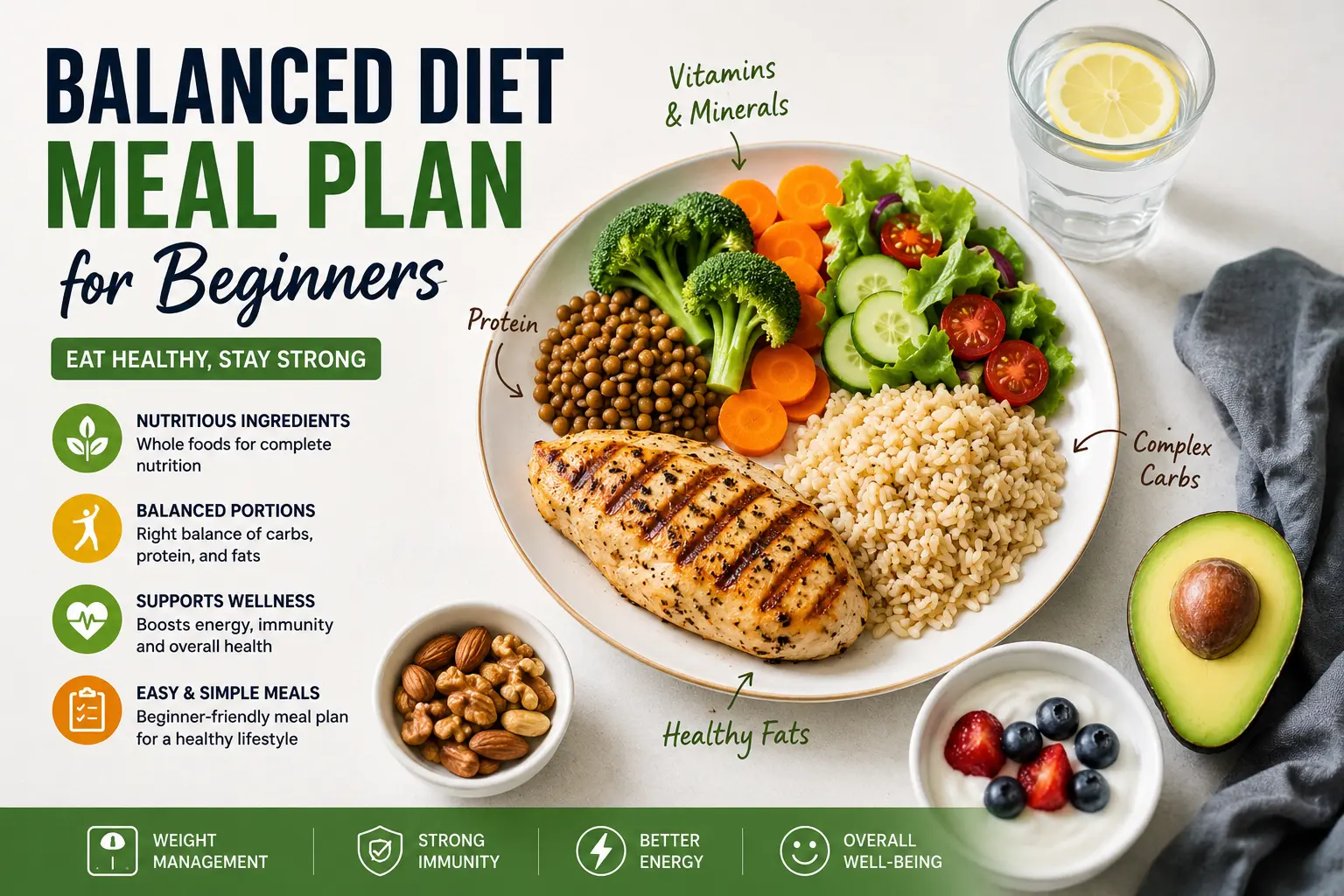
Article Summary: Starting a balanced diet doesn’t mean confusing rules or expensive ingredients. This guide breaks down exactly what a balanced diet meal plan looks like, how to build one yourself using a simple framework, and how to keep it going once the first week of motivation wears off. You’ll also get a full 7-day sample plan to work from.
This article is educational and not a substitute for personalized medical or nutritional advice. If you have a health condition or specific dietary needs, talk with a doctor or registered dietitian before making significant changes to your eating habits.
Introduction
If you’ve ever typed “how to eat healthier” into a search bar at 11 p.m., you already know the problem: everyone has an opinion, and most of them contradict each other. One site tells you to cut carbs. Another says carbs are essential. A third wants you to buy six supplements before breakfast. It’s exhausting, and it’s usually the reason people give up before they even start.
A balanced diet meal plan cuts through that noise. At its core, it’s a way of structuring your meals so your body consistently gets a mix of protein, carbohydrates, healthy fats, and produce — without extreme restriction or complicated math. It’s less a “diet” in the trendy sense and more a framework you can lean on for years, not just a few weeks. If you want to understand what a balanced diet really means before diving into the how-to, that foundation is exactly what this guide starts with.
This guide is built for real beginners. You won’t need a nutrition degree, a food scale, or a pantry full of unfamiliar ingredients. What you will get is a clear explanation of the food groups that matter, a step-by-step method for building any meal, a full week of sample meals to get you started, and practical tips for eating this way on a normal budget and schedule. By the end, you should feel like you actually know what to put on your plate — and why.
What Is a Balanced Diet Meal Plan?
A balanced diet meal plan is a way of organizing your meals so that each one includes an appropriate mix of protein, carbohydrates, healthy fats, and nutrient-rich foods like fruits and vegetables. Instead of eliminating entire food groups or following rigid calorie targets, it focuses on proportion and variety.
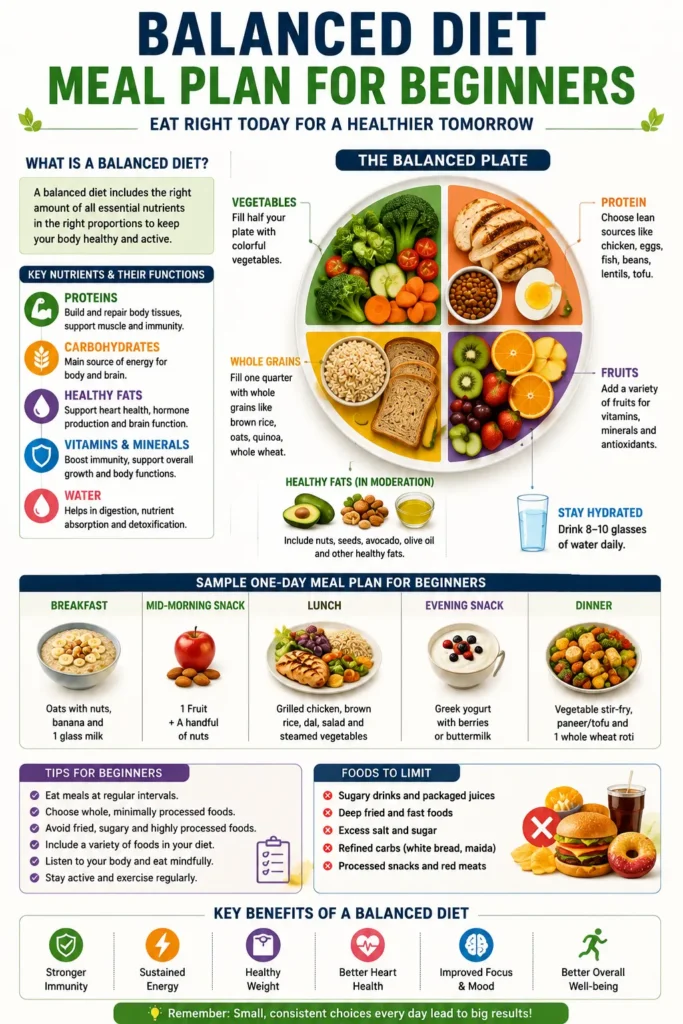
Think of it as a loose structure rather than a strict rulebook. A common approach — one reflected in the USDA’s MyPlate guidelines and general healthy-eating guidance from the World Health Organization — is to fill roughly half your plate with fruits and vegetables, and split the rest between protein and whole grains or starchy carbohydrates, with a smaller amount of healthy fat rounding things out.
This is different from many popular diets you’ve probably heard of, which often ask you to avoid entire categories of food. A balanced approach skips that trade-off entirely. It’s designed to flex around a normal, imperfect week rather than demand you overhaul your whole life overnight.
Why a Balanced Diet Matters for Beginners
Strict, restrictive eating plans tend to work great for about two weeks. Then life happens — a busy stretch at work, a birthday party, a rough day — and the whole thing falls apart because there’s no room to bend.
A balanced approach solves this by design. Because you’re not cutting out major food groups, there’s no “cheat day” mentality to manage, and no all-or-nothing pressure hanging over every meal. That matters more than it sounds like it would. Most people don’t fail at healthy eating because they lack willpower; they fail because the plan they were following wasn’t built to survive a normal, imperfect life.
There are also real, practical benefits to eating this way. Meals that combine protein, fiber, and healthy fats tend to keep you fuller for longer and help avoid the energy crashes that come from meals built mostly around refined carbohydrates. Over time, this kind of consistent, varied eating supports steadier energy throughout the day and can make weight management feel far less like a battle.
| Approach | Flexibility | Sustainability | Nutritional Completeness |
| Balanced diet meal plan | High — adapts to your schedule, budget, and preferences | High — no food groups eliminated, easy to maintain long-term | High — includes all major nutrient groups |
| Restrictive/fad diets | Low — strict rules, little room for real life | Low — often abandoned within weeks | Variable — may lack certain nutrients depending on the diet |
If you’ve tried and stopped diets before, that’s not a personal failure — it’s often a sign the structure itself wasn’t realistic. A balanced plan is built to fit around your life instead of the other way around.
The Core Food Groups to Include
Before you can build a balanced meal, it helps to understand what you’re actually balancing. There are a handful of core food groups that show up in nearly every balanced eating framework, and each one plays a distinct role in how your body functions day to day.
| Food Group | Example Foods | Key Nutrients Provided | General Daily Guidance |
| Protein | Chicken, fish, eggs, beans, tofu | Amino acids for muscle repair and growth | Included at most meals |
| Carbohydrates (whole grains/starches) | Brown rice, oats, whole wheat bread, sweet potatoes | Energy, B vitamins, fiber | Included at most meals, in moderate portions |
| Fruits & vegetables | Leafy greens, berries, broccoli, citrus | Vitamins, minerals, fiber, antioxidants | Roughly half your plate |
| Healthy fats | Olive oil, avocado, nuts, seeds | Essential fatty acids, vitamin absorption support | Small amounts throughout the day |
| Dairy or alternatives | Yogurt, milk, fortified plant milk | Calcium, vitamin D, protein | Included as needed based on preference |
Protein, Carbohydrate, and Fat Basics
These three — often called macronutrients — do most of the heavy lifting in your diet. Protein supports muscle repair and keeps you feeling satisfied after a meal; good sources include lean meats, fish, eggs, beans, and tofu. Carbohydrates are your body’s primary energy source, and whole grains like brown rice, oats, and whole wheat products come with the added benefit of fiber, which refined carbs like white bread typically lack.
Fat has an undeserved bad reputation. In reasonable amounts, healthy fats from sources like olive oil, avocados, nuts, and seeds actually help your body absorb certain vitamins and support long-term health. You don’t need to measure any of this down to the gram — a general rule of thumb is to include a source of protein, a portion of whole grains or starchy vegetables, and a small amount of healthy fat at most meals.
Common Mistake: Grabbing a packaged snack labeled “healthy” without checking whether it actually offers any protein or fiber. Plenty of snack packaging leans on buzzwords rather than nutrition — a quick glance at the ingredient list tells you more than the front of the box does.
Fruits and Vegetables, and Fiber
This is the category most beginners underestimate. Fruits and vegetables aren’t just “extras” — they’re where most of your vitamins, minerals, and fiber come from. Fiber in particular plays a quiet but important role: it supports digestion and helps you feel full longer, which makes it easier to avoid the mid-afternoon snack spiral.
Variety matters here more than perfection. Leafy greens, colorful vegetables, berries, and legumes like lentils and chickpeas all bring something slightly different to the table nutritionally, so rotating what you eat over the week is more useful than eating the same broccoli every single day.
HealthWend Tip: Pick one new protein source and one new vegetable to try each week. It’s a small swap that keeps meals interesting without requiring you to redesign your whole plan.
Hydration Basics
It’s easy to forget water when you’re focused on food, but hydration is part of a balanced approach too. Needs vary from person to person based on activity level, climate, and overall health, so there’s no single number that applies to everyone. If you notice you haven’t had anything to drink since your last meal, that’s usually a good cue to top up rather than waiting until you’re actually thirsty — keeping a water bottle within reach makes that habit almost automatic.
How to Build a Balanced Meal (Step-by-Step Framework)
This is the part that actually changes how you eat, so it’s worth slowing down here. Instead of memorizing a fixed meal plan, use this framework to build any meal, any day, with whatever ingredients you have on hand — including the days when your fridge feels nearly empty and you’re working with whatever’s left.
Step 1: Start with your plate as a visual guide. Picture it divided into sections rather than thinking in exact measurements.
Step 2: Fill about half with fruits and vegetables. Mix colors and types when you can — a plate of only potatoes doesn’t count, but roasted vegetables plus a side salad does.
Step 3: Add a palm-sized portion of protein. Chicken, fish, eggs, tofu, beans, or lentils all work here.
Step 4: Include a serving of whole grains or starchy carbs. Brown rice, quinoa, whole wheat pasta, or a sweet potato are all solid choices.
Step 5: Round it out with a small amount of healthy fat. A drizzle of olive oil, a few slices of avocado, or a small handful of nuts is usually enough.
Step 6: Adjust for the meal type. Breakfast might swap “protein and grains” for eggs and whole grain toast; a snack might just be one or two of these categories rather than all four.
The real value of this method is that it works everywhere — cooking at home, packing a lunch, or even ordering takeout. You’re not following someone else’s fixed plan; you’re applying a repeatable pattern to your own life.
Common Mistake: Treating this framework like a strict recipe instead of a flexible pattern. If a meal doesn’t hit every single category — say, dinner is just protein and vegetables with no grain — it still counts. The goal is a general shape, not a perfect checklist every time.
Eating Out and Staying Balanced
Eating out or grabbing takeout doesn’t mean abandoning the framework — it just means applying it to a menu instead of your own kitchen. At a restaurant, look for a protein-forward main, ask for a vegetable side instead of fries when it’s an option, and treat bread baskets or chips as the “small extra” rather than the base of the meal. The same logic works for delivery apps: a grain bowl, a burrito with beans and vegetables, or a stir-fry with rice all map onto the plate framework almost exactly.
This is especially useful if lunch usually means eating at your desk or grabbing something between meetings. A packed lunch built the night before — grain, protein, and a vegetable in separate containers — travels just as well as a restaurant meal, and gives you the same balance without needing a kitchen anywhere nearby.
Breakfast, Lunch, Dinner, and Snack Examples
Breakfast: Scrambled eggs with spinach, a slice of whole grain toast, and a small side of berries.
Lunch: A grain bowl with brown rice, black beans, roasted vegetables, and a drizzle of olive oil.
Dinner: Baked salmon, a side of steamed broccoli, and a small portion of quinoa.
Snack: Greek yogurt with a handful of walnuts and sliced fruit.
None of these require special equipment or hard-to-find ingredients — they’re built from the same core groups described above, just recombined.
Build a Balanced Plate Checklist
| Plate Component | Included? | Notes |
| Protein source | ☐ | Palm-sized portion |
| Whole grain or starchy carb | ☐ | About one cupped handful |
| Fruits and/or vegetables | ☐ | Aim for half the plate |
| Healthy fat | ☐ | Small amount is enough |
| Water or hydration | ☐ | Throughout the meal |
[Internal Link Opportunity: Link to “Macronutrients Explained” here for readers who want a deeper dive into protein, carbs, and fats.]
Sample 7-Day Balanced Diet Meal Plan
Use this as a flexible starting template, not a strict script. Swap meals around based on what’s in your fridge, what’s on sale, or what you’re actually in the mood for — the structure is what matters, not the exact menu.
| Day | Breakfast | Lunch | Dinner |
| Monday | Oatmeal with berries and a spoon of peanut butter | Turkey and veggie wrap with a side salad | Grilled chicken, roasted sweet potato, green beans |
| Tuesday | Greek yogurt with granola and fruit | Lentil soup with whole grain bread | Stir-fried tofu with brown rice and mixed vegetables |
| Wednesday | Scrambled eggs with whole wheat toast | Quinoa salad with chickpeas and cucumber | Baked fish, roasted broccoli, small baked potato |
| Thursday | Smoothie with spinach, banana, and protein source | Leftover stir-fry from Tuesday | Turkey chili with a side of cornbread |
| Friday | Whole grain toast with avocado and egg | Grilled chicken salad with mixed greens | Whole wheat pasta with vegetables and lean ground turkey |
| Saturday | Vegetable omelet with fruit on the side | Black bean tacos with cabbage slaw | Baked salmon, quinoa, roasted asparagus |
| Sunday | Whole grain pancakes with fruit | Leftover chili or soup | Roast chicken, brown rice, steamed vegetables |
If a full week feels like a lot to plan at once, start with just two or three days and build from there. Many parents find it easier to plan dinners first, since that’s usually the meal the whole family eats together — pick two or three dinners for the week, then build breakfast and lunch around whatever’s already in the kitchen instead of planning nine separate meals from scratch.
HealthWend Tip: Cook extra protein and grains on nights you’re already making dinner, then repurpose the leftovers into the next day’s lunch. It cuts prep time roughly in half without any extra planning.
suggest: Balanced Diet Benefits: Why It Matters for Your Health
[Internal Link Opportunity: Link to a downloadable “7-Day Balanced Diet Meal Plan” printable here.]
Portion Guidance Without a Scale
You don’t need a food scale to eat a balanced diet — your hands are a surprisingly reliable measuring tool, and they’re always with you.
- Palm-sized portion ≈ a serving of protein
- Cupped hand ≈ a serving of grains or starchy carbs
- Fist-sized portion ≈ a serving of vegetables
- Thumb-sized portion ≈ a serving of fat, like nut butter or oil
These aren’t exact scientific measurements — dietitians often teach hand-based portioning specifically because it’s consistent enough to get you in the right range without obsessing over grams. If you’re eating out or at a desk with a packed lunch, this method works just as well as it does at home; you’re simply eyeballing proportions instead of pulling out a scale in the office kitchen.
Pro Tip: When a plate looks “off,” it’s usually not portion size — it’s proportion. A huge pile of pasta with a sprinkle of vegetables on the side is a proportion problem, not a portion problem.
Budget-Friendly Tips for Beginners
Balanced eating has a reputation for being expensive, but that reputation doesn’t hold up in practice. Some of the most nutrient-dense foods — beans, lentils, oats, frozen vegetables, and eggs — are also some of the cheapest items in the grocery store.
A few practical swaps make a real difference over time. Buying grains and legumes in bulk instead of pre-packaged single servings cuts cost significantly. Frozen fruits and vegetables are just as nutritious as fresh in most cases. They also last far longer and are often cheaper, especially out of season. Batch cooking a big pot of rice, beans, or roasted vegetables on a Sunday can cover several meals throughout the week, which saves both money and the mental energy of cooking from scratch every night.
For students or anyone cooking for one, buying smaller quantities of fresh produce more frequently — rather than a large haul that goes bad before you finish it — tends to reduce waste and, ultimately, cost. And if you’re feeding a family, building meals around a shared base, like a big batch of chili or a tray of roasted vegetables, that gets portioned differently for kids and adults is usually more efficient than cooking two separate meals.
[Internal Link Opportunity: Link to “How to Meal Prep for Beginners” here.] [Internal Link Opportunity: Link to “Healthy Grocery List for Beginners on a Budget” here.]
suggest: Balanced Diet Chart: A Complete Guide to Healthy Eating
Common Mistakes to Avoid
Even with a solid framework, a few habits tend to trip people up early on.
Myth vs. Fact
| Myth | Fact |
| Skipping meals helps you eat less overall | Skipping meals often leads to overeating later, since you arrive at your next meal overly hungry |
| Balanced eating means cutting out carbs or fat | A balanced approach includes moderate amounts of all major food groups, not elimination |
| “Balanced” means bland or boring | Balanced meals can include a wide range of cuisines, spices, and flavors — the structure is flexible |
| You need to weigh and measure everything | Hand-based portion guidance is accurate enough for everyday use |
Beyond these myths, one of the most common mistakes is treating the first week as a test of perfection rather than a starting point. If Tuesday’s dinner doesn’t line up with the plan, that’s not a failure — it’s just Tuesday. The goal is a general pattern over time, not a flawless streak, which is exactly the mindset that makes it possible to stick with this past the first few weeks.
Staying Consistent Long-Term
The first week of any new eating pattern is usually the easy part — motivation is high, and everything feels new. The real test comes a few weeks in, once the novelty wears off and regular life starts crowding back in. If you’ve started and stopped healthy eating before, this is probably the exact point where it happened, and that’s worth naming rather than glossing over.
A few things help here. First, build in flexibility on purpose rather than treating it as a failure when plans change. If you know Fridays are chaotic, plan something simple and repeatable for that day instead of pretending it’ll go perfectly. Second, keep a very simple way of tracking your consistency — not calories, just whether your meals generally followed the framework.
HealthWend Tip: The first time a day goes completely off track, the fix isn’t waiting until Monday to “start over.” Just pick up at your very next meal. Building healthy eating habits is less about a clean streak and more about how quickly you return to the pattern after it slips.
Weekly Progress Check-In
| Day | Meals Balanced (Y/N) | Water Intake | Notes |
| Monday | |||
| Tuesday | |||
| Wednesday | |||
| Thursday | |||
| Friday | |||
| Saturday | |||
| Sunday |
You don’t need every box checked to call the week a success. What matters is the overall pattern — most meals following the framework, most days, most weeks.
Key Takeaways
- A balanced diet meal plan focuses on proportion and variety, not restriction — protein, carbs, healthy fats, and produce all have a place on your plate.
- The plate-building framework (roughly half fruits/vegetables, a palm of protein, a cupped hand of grains, a thumb of fat) works for any meal, anywhere, including restaurants and desk lunches.
- You don’t need a food scale — hands make a reliable, portable portion guide.
- Balanced eating can be budget-friendly by leaning on beans, lentils, oats, eggs, and frozen produce.
- Consistency over time matters far more than any single “perfect” day.
Frequently Asked Questions
What is a balanced diet meal plan? A balanced diet meal plan is a way of structuring meals so they include an appropriate mix of protein, carbohydrates, healthy fats, and produce. Rather than eliminating food groups, it focuses on proportion, variety, and consistency, making it a realistic long-term approach to eating well.
How do I create a balanced diet meal plan as a beginner? Start with the plate-building framework: fill about half your plate with fruits and vegetables, add a palm-sized portion of protein, a cupped hand of whole grains, and a small amount of healthy fat. Apply this pattern to a few meals at a time rather than overhauling your entire week at once.
How many meals and snacks should be in a daily plan? There’s no single correct number for everyone — three balanced meals with one or two snacks works well for many people, but what matters most is that your overall day includes a good mix of food groups, spread in a way that fits your schedule and hunger levels.
What foods should be included in every balanced meal? As a general guideline, most balanced meals include a source of protein, a portion of whole grains or starchy carbs, some fruits or vegetables, and a small amount of healthy fat. Not every single snack needs all four, but most full meals benefit from this mix.
Can I follow a balanced diet meal plan on a tight budget? Yes. Some of the most affordable foods — beans, lentils, oats, eggs, and frozen fruits and vegetables — are also among the most nutrient-dense. Buying in bulk and batch cooking can stretch your grocery budget further while still keeping meals balanced.
How do I balance meals without counting calories? Use proportion instead of numbers. The hand-based portion method and the plate-building framework are designed specifically to help you eat balanced meals without tracking calories or macros in detail.
Is a balanced diet meal plan good for weight loss? A balanced approach can support weight management because meals built around protein, fiber, and healthy fats tend to be more filling and help avoid energy crashes that lead to overeating. That said, individual weight loss goals vary, and it’s worth speaking with a healthcare provider or registered dietitian for personalized guidance.
How do I adjust a balanced meal plan for a family? Build meals around a shared base — like a big batch of chili, roasted vegetables, or a grain bowl — and adjust portions or toppings for kids versus adults. This keeps cooking simple while still letting everyone’s plate look a little different.
What are common mistakes people make when starting a meal plan? Skipping meals, cutting out entire food groups, assuming balanced eating has to be bland, and expecting perfection from day one are some of the most common early missteps. Treating the framework as a flexible pattern rather than a strict rulebook helps avoid all of these.
How long does it take to see results from balanced eating? This varies by person and by goal. Some people notice steadier energy within a couple of weeks, while other changes, like weight management, tend to unfold more gradually over months. Consistency matters more than speed here.
Conclusion
Eating a balanced diet doesn’t take perfection, expensive ingredients, or a nutrition degree. It takes a simple, repeatable framework you can apply to whatever’s actually in your kitchen — or on a restaurant menu — on a given day. Once you get comfortable filling your plate with a mix of protein, whole grains, produce, and healthy fats, the guesswork mostly disappears.
Start small. Pick two or three days this week and try building your meals using the plate method described here. You don’t need to get every meal right immediately — you just need a pattern worth returning to, week after week. That’s the real point of a balanced diet meal plan: not a short-term fix, but a way of eating that’s still just as doable a year from now.
Calls to Action
Primary CTA: Ready to put this into practice? Download our free printable 7-day balanced meal plan and start building better meals this week.
Secondary CTA: Want more beginner-friendly nutrition guidance delivered straight to your inbox? Subscribe to the HealthWend newsletter.
Internal Link CTA: New to cooking ahead of time? Check out our guide on how to meal prep for beginners to make this framework even easier to stick with.
This article is for educational purposes only and is not a substitute for personalized medical or nutritional advice. If you have a health condition or specific dietary needs, please consult a doctor or registered dietitian before making significant changes to your eating habits.