


Reviewed by the HealthWend Editorial Team · Last updated: September 2026
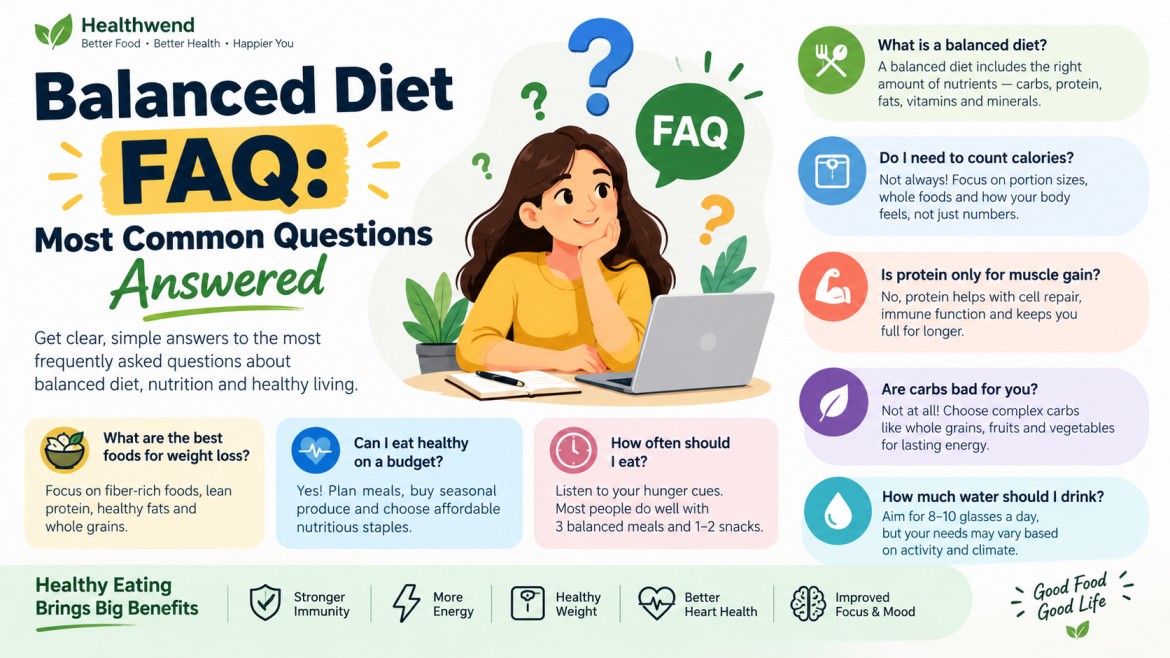
Article Summary: This balanced diet FAQ — one of the most searched topics in everyday nutrition — answers the questions people ask most: what balance actually means, how to build a plate without a food scale, and how to eat well on a busy schedule or tight budget. You’ll find myth-busting, a nutrient table, a sample day, and a checklist you can use today.
Introduction
If you’ve ever typed “balanced diet faq” into a search bar at 11pm, hoping for a straight answer, you’re not alone. Between fad diets, conflicting headlines, and well-meaning advice from every corner of the internet, it’s easy to feel like “balanced eating” is some secret code you haven’t cracked yet.
Here’s the good news: it’s simpler than it looks.
This FAQ was built to answer the questions real people ask most — not textbook definitions, but the practical stuff. What actually counts as balanced? Do you need to weigh your food? Can you still order takeout on a Friday night? We’ll walk through all of it, grounded in guidance from organizations like the USDA and WHO, without turning it into a strict rulebook you have to follow perfectly.
By the end, you should have a clear, workable idea of what balanced eating looks like for you — not for a magazine cover, just for a regular week.
This article is for educational purposes only and is not a substitute for personalized medical or dietetic advice. If you have specific health conditions or concerns, talk with a doctor or registered dietitian.
What Is a Balanced Diet?
A balanced diet is one that includes a variety of foods from each major food group — fruits, vegetables, whole grains, protein, and dairy or alternatives — in amounts that meet your body’s nutrient needs. It’s less about perfection and more about consistency over time.
That’s the short version. The longer version is that balance isn’t a fixed formula. It doesn’t mean identical portions at every meal, and it definitely doesn’t mean cutting out entire food groups because a headline told you carbs or fats are “bad.” Your body needs a mix of macronutrients (protein, carbohydrates, and fats) and micronutrients (vitamins and minerals) to function well, and no single food provides everything.
What balance really comes down to is variety and proportion. Picture most of your plate, most of the time, made up of a mix of vegetables, whole grains, lean proteins, fruits, and healthy fats. There’s room for flexibility depending on your day, your culture, your budget, and your preferences.
It also helps to think in terms of a week rather than a single meal. One indulgent dinner or a rushed breakfast of just toast doesn’t undo balance. It’s the overall rhythm of your eating — not any one plate — that actually matters.
Food Groups and Portions Explained
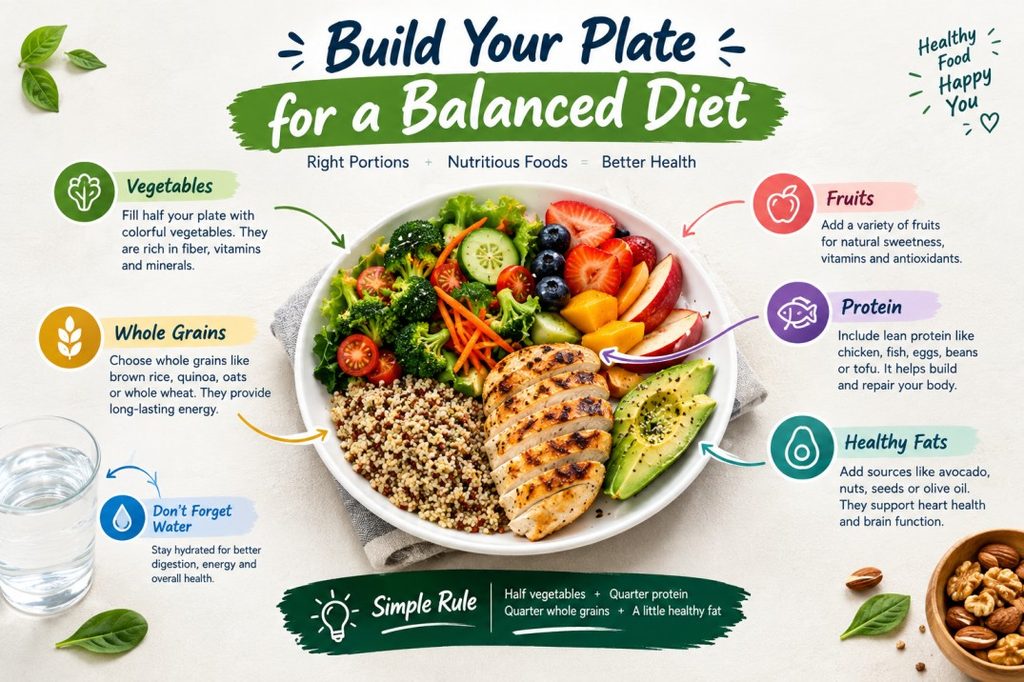
You don’t need a kitchen scale to eat balanced meals. A simple visual tool — often called the “plate method” — can get you most of the way there. Picture your plate divided roughly like this: about half filled with vegetables and fruits, a quarter with whole grains or starchy vegetables, and a quarter with a protein source. Add a small serving of dairy or a dairy alternative on the side, and you’ve got a solidly balanced meal.
Everyone’s a little different, though — age, activity level, and health goals all shift what “enough” looks like — so treat this as a starting point, not a test you can fail. [Internal Link Opportunity: “Portion Control: A Beginner’s Guide”]
Here’s a quick-reference table to keep handy:
| Food Group | Example Foods | General Portion Guidance |
|---|---|---|
| Vegetables | Leafy greens, broccoli, peppers, carrots | About a quarter to half of your plate |
| Fruits | Berries, apples, citrus, bananas | 1–2 servings per meal or as snacks |
| Whole Grains | Brown rice, oats, whole wheat bread, quinoa | About a quarter of your plate |
| Protein | Chicken, fish, eggs, beans, tofu, lentils | A palm-sized portion |
| Dairy or Alternatives | Milk, yogurt, cheese, fortified plant milk | A small serving alongside meals |
This general split mirrors the same starting framework many registered dietitians use with clients — half the plate in produce, a quarter in whole grains, a quarter in protein — because it’s simple enough to remember without needing to measure anything. [Internal Link Opportunity: “What Is a Balanced Plate? A Visual Guide”]
Common Mistake: Treating the plate method as an exact measurement rather than a rough guide. If your dinner is closer to 40% vegetables than a precise half, that’s not a failure — it’s still a balanced meal.
Common Balanced Diet Questions
These are the questions that come up again and again — the ones people search for right after they’ve read a basic definition and still feel unsure.
What exactly counts as a “balanced diet”?
In practice, it means eating a variety of foods across the major food groups in proportions that work for your body, rather than following one rigid formula. Two people can both eat “balanced” diets that look quite different from each other, depending on their culture, preferences, and health needs. What matters is variety, nutrient density, and consistency — not matching a single ideal plate.
How many food groups should I eat from each day?
Ideally, you’ll touch on all five groups — vegetables, fruits, grains, protein, and dairy or alternatives — over the course of a day. You don’t need every group at every meal. Breakfast might lean on grains and dairy, while lunch and dinner bring in more vegetables and protein. Spreading things out across the day is completely normal.
Do I need to count calories to eat a balanced diet?
Not necessarily. Plenty of people eat balanced, nourishing diets without ever tracking a single calorie. Calorie counting can be useful for specific goals, like managing weight under a doctor’s or dietitian’s guidance, but it isn’t a requirement for balance. Paying attention to variety and portion sizes goes a long way on its own — a helpful habit is simply noticing hunger and fullness cues rather than reaching for a calculator.
Can I still eat treats or fast food occasionally?
Yes. Balance is about the shape of your eating over time, not any single meal or day. Having pizza on a Friday night or grabbing a burger when you’re short on time doesn’t cancel out an otherwise nutrient-rich week. Trying to eliminate every “unhealthy” food from your diet often backfires and can make eating feel stressful rather than sustainable.
How is a balanced diet different for kids vs. adults?
Children have different nutrient and calorie needs than adults, and those needs shift again as they grow. The general principles — variety, proportion, minimizing highly processed foods — still apply, but specific portion sizes and nutrient priorities (like calcium and iron during growth spurts) can differ.
If you’ve ever packed a school lunch for a picky eater, you know the theory doesn’t always survive contact with a five-year-old’s opinions. A realistic approach is offering one food you know they’ll eat alongside one or two you’re introducing, rather than aiming for a perfectly balanced lunchbox every single day. If you’re planning meals for a child regularly, it’s worth checking age-specific guidance or speaking with a pediatrician or registered dietitian.
Do I need supplements if my diet is balanced?
For most healthy adults eating a varied diet, supplements aren’t strictly necessary. That said, some people — including pregnant individuals, older adults, or those with specific dietary restrictions — may benefit from certain supplements, since individual nutrient needs vary more than a general diet framework can account for. This really depends on your situation, so it’s best to check with a healthcare provider before adding anything new rather than guessing.
What are the biggest myths about balanced diets?
Probably the two biggest are that carbs and fats are inherently “bad,” and that one off-track meal ruins your progress. Neither holds up — we’ll walk through these and a few other common myths in detail below.
Also Read: Balanced Diet Meal Plan for Beginners
Balanced Eating on a Budget or Busy Schedule
Here’s something that doesn’t get said enough: balanced eating doesn’t require a big grocery budget or hours in the kitchen. Beans, lentils, eggs, frozen vegetables, canned fish, and whole grains like rice and oats are all affordable, shelf-stable, and packed with nutrients. Frozen produce, in particular, is often just as nutritious as fresh and tends to be cheaper — plus it doesn’t go bad in your fridge while you’re too busy to cook.
How do I balance meals on a tight budget? Lean on the pantry staples above, buy produce in season or frozen, and don’t feel pressure to prioritize specialty items. A can of beans and a bag of frozen spinach do real nutritional work for a fraction of the cost of pre-packaged “healthy” meals.
What does a balanced diet look like for someone who doesn’t cook much? More achievable than you’d think. If mornings are chaotic, overnight oats with fruit or a yogurt bowl can cover more food groups than expected with almost no active prep. If you’re eating out — whether that’s a work lunch or dinner with friends — look for a plate with a visible protein and vegetable component, and treat the rest as flexible; most menus have at least one combination that fits. For a cafeteria or fast-food lunch, a base of protein and vegetables, with a grain added if you can, usually gets you there. [Internal Link Opportunity: “Healthy Meal Planning on a Budget”]
And on nights when cooking feels like too much, a simple plate of eggs, canned beans, and whatever vegetables are in the fridge counts as a legitimately balanced dinner. It doesn’t need to be elaborate to count.
HealthWend Tip: Cook a double batch of a base grain or protein — brown rice, roasted chicken, a pot of lentils — once or twice a week. Having it ready in the fridge turns “I’m too tired to cook” into a five-minute assembly job instead of a from-scratch meal.
Here’s what a realistic balanced day might look like:
| Meal | Example |
|---|---|
| Breakfast | Oatmeal with berries and a splash of milk |
| Lunch | Grilled chicken, brown rice, and roasted vegetables |
| Dinner | Bean and vegetable stir-fry with whole grain noodles |
| Snacks | An apple with peanut butter, or yogurt with a handful of nuts |
None of this requires special ingredients or a free evening — it’s the kind of day that fits around a regular work or family schedule, not one built around it.
Myths vs. Facts About Balanced Diets
A lot of the confusion around balanced eating comes from myths that sound convincing but don’t hold up. If you’ve internalized a few of these without realizing it, you’re in good company — most of us have absorbed at least one version of diet-culture messaging somewhere along the way. Let’s clear a few up.
Whole grains, fruits, and legumes are core parts of a balanced diet, providing fiber and energy your body relies on — carbohydrates simply aren’t the villain some headlines make them out to be. Healthy fats from sources like olive oil, nuts, and fish support several important body functions, so cutting fat entirely tends to backfire rather than help. And eating “perfectly” at every meal was never actually the goal; that mindset tends to create more stress around food, not less.
| Myth | Fact |
|---|---|
| “Carbs are bad for you.” | Whole grains, fruits, and legumes are nutrient-dense carbohydrate sources that support a balanced diet. This myth largely traces back to low-carb diet trends that lumped refined and whole grains together. |
| “Balanced means eating the same thing every day.” | Balance is about your overall pattern over days or weeks, not identical daily meals. |
| “You have to cut out sugar and fat completely.” | Moderate amounts of added sugar and healthy fats can fit into a balanced diet. |
| “Balanced eating is expensive.” | Affordable staples like beans, oats, frozen vegetables, and eggs support balanced eating on a budget. This myth often comes from comparing pre-made “healthy” products to basics, rather than comparing basics to basics. |
| “One unhealthy meal ruins your progress.” | A single meal doesn’t define your overall eating pattern — consistency over time is what matters. |
The overall pattern of what you eat over time — not any single food or meal — is what actually shapes long-term health, which is really the heart of what “balanced” means.
Common Mistake: Cutting out an entire food group after one bad experience, a viral trend, or a single unflattering headline. Unless a doctor or dietitian has advised it for a specific health reason, most food groups have a place in a balanced diet.
Simple Tips to Get Started
If all of this feels like a lot, start small. You don’t need to overhaul your entire diet this week.
- Add one extra serving of vegetables to a meal you already eat regularly.
- Swap a refined grain (white bread, white rice) for a whole grain version when you can.
- Keep a couple of quick, balanced go-to meals ready for the nights you’re running on empty.
- Judge your week, not your Tuesday dinner.
- If you slip back into old habits for a day, just pick back up at the next meal — no need to “start over” on a Monday.
How long does it take to see results from eating more balanced? It varies by person and by what you mean by “results.” Many people notice steadier energy within a couple of weeks of adding more variety and protein to their meals, while changes tied to weight or lab markers typically take longer and depend on other factors too. Rather than watching for a single milestone, look for smaller signs along the way — fewer energy crashes, feeling satisfied after meals, less mental effort spent deciding what to eat.
Common Mistake: Fixating on one “perfect” meal instead of the pattern across the week. A single great dinner doesn’t guarantee balance any more than a single rough one ruins it — it’s the accumulation that counts.
Quick Checklist: Signs Your Diet Is Balanced
Run through this list and see how many feel true for you — you don’t need a perfect score.
- ✓ You regularly eat vegetables and fruit, most days
- ✓ Your meals usually include a protein source
- ✓ You include whole grains at least some of the time
- ✓ You’re not avoiding entire food groups without a medical reason
- ✓ You drink water regularly throughout the day
- ✓ You can enjoy treats without guilt spiraling into restriction
If most of these feel true for you, you’re likely eating a reasonably balanced diet already — even if it doesn’t look like a magazine spread, and even if last Tuesday didn’t check every box.
Key Takeaways
- A balanced diet means variety and proportion across food groups, not perfection at every meal.
- The plate method (half vegetables/fruit, a quarter grains, a quarter protein) is a simple way to visualize balance without measuring.
- You don’t need to count calories or cut out entire food groups to eat well.
- Balanced eating is achievable on a budget and with a busy schedule — it doesn’t require elaborate meals.
- Judge your eating pattern across the week, not any single meal or day.
Conclusion
Balanced eating carries a reputation for being complicated, but underneath the noise, it’s fairly forgiving. It’s about regularly including a mix of vegetables, fruits, whole grains, protein, and dairy or alternatives — not hitting some impossible daily target. Treats, busy weeks, and imperfect days are part of the picture, not exceptions to it.
If you take one thing from this FAQ, let it be this: you don’t need a perfect plate to be eating well. Small, consistent choices — a bit more variety here, a whole grain swap there — add up over time far more than any single “ideal” meal ever could.
Suggestion : Balanced Diet: What It Means, Benefits & Sample Diet Chart
What to Do Next
Want simple nutrition tips like this delivered regularly? Join the HealthWend newsletter for practical, no-nonsense guidance you can actually use.
Grab our free Balanced Plate Checklist to keep this framework handy next time you’re planning a meal.
Curious what a balanced plate actually looks like in practice? [Internal Link Opportunity: “What Is a Balanced Plate? A Visual Guide”]
Medical Disclaimer: This article is for educational purposes only and is not a substitute for professional medical or dietetic advice. Individual nutrition needs vary — consult a doctor or registered dietitian for guidance specific to your health.